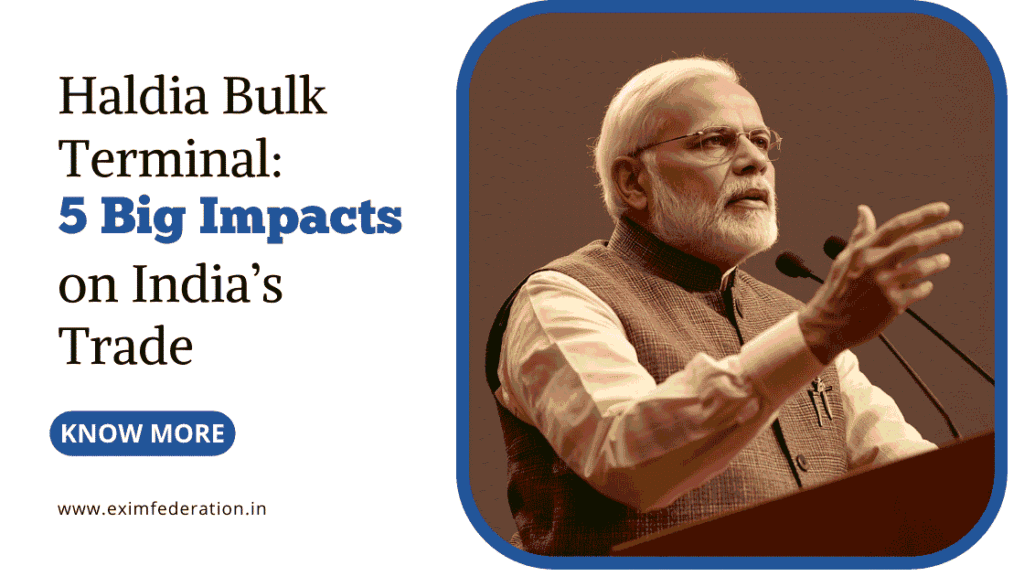
PM Modi Inaugurates APSEZ’s Haldia Bulk Terminal: India’s First Fully Automated Bulk Facility.

Transform Your Business Into a Global Brand with Exim Federation

Haldia Bulk Terminal: 5 Big Impacts on India’s Trade

Latest updates

Shubham Pawar - From  Exim Federation

From - Shubham D Pawar

Exim Federation By Dattasa Environment

Haldia Bulk Terminal 2026: Hidden Boost for Export Trade

India’s maritime infrastructure is already into the new phase of world class modernization. The recent inauguration of Haldia Bulk Terminal, developed by India’s very own & prominent Adani Ports and Special Economic Zone (APSEZ), marks another & one of the most significant milestone in the country’s port development & International business in terms of Import export business and connectivity.

The terminal was inaugurated by our honorable Prime Minister of India Shri. Narendra Damodardas Modi and is being recognized as India’s first & only fully automated dry bulk cargo handling facility.

Located in Haldia, Eastern India’s one of the most important port zones, this project represents more than just an infrastructure expansion. It signals India’s push toward smart ports, improved logistics efficiency, connectivity and stronger export competitiveness especially for those who are far away from the sea shore.

For industries that depend very heavily on bulk cargo & commodities —like  steel, coal, fertilizers and cement etc—this development could reshape supply chain dynamics across eastern India.

India’s Haldia Bulk Terminal transforming eastern region trade and export infrastructure

The Strategic Role of Haldia in India’s Trade , Logistics & Connectivity Network.

The Haldia region has long served as a key maritime gateway for the eastern part of India. Industries across multiple states such as West Bengal, Jharkhand, Odisha and Bihar nearby region rely heavily on this port & related system for the movement of raw materials, industrial commodities and also for finished goods going to the international market for exports.

Whereas, traditional bulk handling systems have often faced several operational challenges like:

  • slower cargo unloading speeds
  • higher manual handling costs.
  • cargo losses during transfer.
  • longer vessel turnaround time.
  • Shortage & dependency of skilled labours

These issues mainly create  inefficiencies that can increase logistics costs for importers and exporters.

The newly launched APSEZ Haldia Bulk Terminal has been designed to address these challenges through advanced automation and modern cargo handling technology.

What actually Makes the Haldia Bulk Terminal Unique & one of its kind facility for the eastern region of India.

The facility introduces advanced & modern systems that drastically improve the way bulk cargo is managed in Indian ports.

 Fully Automated Cargo Handling

Unlike Traditional old school type conventional terminals, the new system uses automated conveyor based cargo movement. This reduces manual handling and most importantly minimizes material losses during cargo transfer.

This Automation also ensures faster unloading of commodities like:

  • coal
  • limestone
  • fertilizers
  • minerals

For industries depending on consistent & steady flow of raw material supply, this can improve operational reliability and reduce the chances of human error.

Faster Vessel Turnaround Time

In maritime trade, vessel waiting time directly affects logistics costs of the products.

Automated bulk terminals reduce potential loading and unloading delays, allowing ships to dock and depart faster. 

This efficiency helps reduce demurrage charges and improves overall port productivity & efficiency.

For import export, this simply means lower shipping costs and better delivery timelines.

Improved Environmental Handling

These modern bulk cargo facilities are also designed to reduce environmental impact.

Advanced dust suppression systems and controlled cargo movement technologies help minimize energy consumption , carbon footprints, pollution and also improve safety standards within the port ecosystem.

Impact on Eastern India’s Industrial Economic growth and dependency

The development of the Haldia Bulk Terminal is particularly important for eastern India’s industrial growth.

Several major sectors stand to benefit from this as follows:

Steel Industry

Steel manufacturing units rely heavily on bulk imports of raw materials like coal and iron ore. Faster cargo handling improves production continuity.

Power Generation

Thermal power plants often depend on imported coal shipments mainly from Australia . Improved logistics efficiency ensures uninterrupted fuel supply.

Fertilizer Industry

Bulk handling automation enables faster movement of raw materials used in fertilizer production, benefiting the agricultural supply chain.

Mineral-Based Industries

Mining and mineral processing companies can reduce logistics costs through faster cargo handling.

Ultimately, improved port efficiency strengthens the industrial competitiveness of eastern India.

Port Automation: The Future of Global Trade

Globally, all Major ports have already embraced automation to improve efficiency and reduce operational costs.

Ports worldwide like Singapore, Rotterdam and Shanghai are the best examples where they have already implemented advanced technologies that allow them to process cargo at significantly higher speeds.

India’s push toward port modernization and process automation reflects an effort to stay competitive in global maritime trade.

Infrastructure projects like the Haldia Bulk Terminal align with India’s broader port based development strategy, which is aiming to integrate ports with industrial corridors, logistics networks and export ecosystems.

 

Want to start & Expand your own Import export Business? Book a free consultation

Entry Form
Select Required Service

Why Trade Advisory Support Still Matters

While infrastructure improvements enhance logistics efficiency, navigating international trade remains complex.

Businesses still need to manage several critical aspects such as:

• customs procedures
• port registrations & AD code linking.

• export documentation • international compliance requirements.

Many growing exporters rely on experienced trade consultants to navigate these processes more effectively.

Organizations like Exim Federation often assist businesses in understanding export-import procedures, regulatory frameworks, and international market opportunities.

With the right guidance, companies can leverage improved infrastructure while minimizing operational risks in global trade.

Real World Export Industry specific Problems

From our past experience working with Indian exporters mainly on following points :

  1. Planning for sales contracts without considering the freight changes, variations & adverse conditions.
  2. Assuming logistics costs remain static.
  3. Ignoring FTA, Trade policy update & sanction updates during geopolitical escalation.
  4. Delaying Export documentation review until rejection.
  5. Lack of proper trade & marine insurance coverage to cover war risk.

These real mistakes cost businesses time & profits — not just Exim Documentation.

Exim Federation's Testimonial's & Reviews

Why Professional Guidance of Exim Federation & experts Matters More Now

In times of geopolitical risk:

  • Errors cost more than we assumed.
  • Governments and banks tighten procedures
  • Market volatility increases and it is very unpredictable.

Professional support ensures:

  • Faster approvals
  • Reduced errors
  • Compliance safety
  • Structured costing and documentation.

At Exim Federation, our focus is more on execution guidance — helping your business act — not just understand concepts.

Conclusion

A New Chapter for India’s Maritime Infrastructure

The inauguration of the Haldia Bulk Terminal represents a significant step in India’s maritime modernization journey.

By introducing automation into bulk cargo handling, the project improves:

  • logistics efficiency in terms of output
    • supply chain reliability within minimal error
    • industrial competitiveness with access to international market
    • export infrastructure

As India continues expanding its global trade footprint, investments in advanced port infrastructure will play a crucial role in supporting economic growth of the nation.

For exporters, importers and industrial sectors, developments like this indicate that India’s logistics ecosystem is evolving rapidly toward faster, smarter and more efficient trade systems.


How Exim Federation Supports International Business Growth

Most of the businesses struggle with challenges like lack of export knowledge, documentation complication, compliance requirements, Market selection and digital visibility.

Without right guidance, Proper consultation for expanding internationally will be complex and risky at the same time.

Exim Federation By Dattasa Environment helps entrepreneurs, exporters, startups and service providers overcome these challenges through structured consultation, Data driven Ai Based Product Nexus Reports & strategic support.

From business setup to international marketing with brand awareness, Exim Federation focuses on practical solutions that help businesses grow globally.

By combining import-export market insights & digital marketing strategies, Exim Federation enables businesses to build trust, generate international leads and scale operations across global markets in a sustainable manner.

Fore more details –
Exim Federation By Dattasa Environment
Import Export & Business Consultant
+91-9403733464
connect@eximfederation.in
www.eximfederation.in

FAQ's

The Haldia Bulk Terminal is India’s first fully automated dry bulk cargo handling facility developed by Adani Ports to improve efficiency in bulk cargo logistics.

Haldia terminal was inaugurated by Prime Minister of India Shri. Narendra Modi as part of India’s port modernization initiatives

The Haldia terminal in Ahmedabad  was developed by Adani Ports and Special Economic Zone (APSEZ), one of India’s largest private port operators.

Automation at Haldia Bulk Terminal mainly improves cargo handling speed, reduces manual intervention, minimizes material loss and shortens vessel turnaround time.

Importers face very high costs due to freight & fuel surcharges, as well as very high possibility of delay in supply.