
4 Steps to select the best Export Product with High Margins.
How to select Right Product for Export: A Startup Framework 4 Steps to select the best Export Product with High Margins. Most of the new export business entrepreneur, startups make similar repetitive mistakes in their first three months. Instead of looking at their own supply chain capabilities, they search online for “most profitable exports” & try to sell whatever is trending in the market. This is how startups with no prior experience or right guidance experience ends up with probable failure or sometimes rejection at the destination port, mainly lucrative western countries like the USA, UK or European market. Product selection is not about chasing trends; It’s all about matching your specific operational strength with a verified international gap. If you want to choose export import product categories that actually generate Opportunities, sales followed by good ROI with profit, you need a structured approach. An informational search is a good start, but from a commercial perspective, your business requires analyzing real trade details, understanding target market compliance and protecting your margins. In this guide, I will walk you through a practical framework for export product research so your startup can identify genuine export opportunities without risking capital blindly. Why Startups Fail During Export Product Research Many beginners assume that a massive global market size means instant buyers. In reality, massive markets are often dominated by established players operating on razor-thin margins. If you choose a product purely because national statistics look impressive, you are fighting the wrong battle. According to the Ministry of Commerce and Industry, India’s total merchandise exports reached an impressive $437.42 billion in FY 2024-25. While the macro data proves the demand is there, it does not mean every product is suitable for a newly registered MSME. A 4-Step Framework to Assess Export Opportunities Before you contact a single international buyer, you must evaluate your product idea logically. Analyze the HS Code Data Every product traded globally is classified by a Harmonized System (HS) code. Use platforms like the Indian Trade Portal to track the specific HS code of your intended product. This data reveals which countries are consistently buying this exact item from India, rather than relying on generic industry news. Audit Your Supply Chain Reliability Startups often act as merchant exporters, meaning they source from local manufacturers. Can your supplier consistently deliver the exact same quality for order number ten as they did for order number one? If the manufacturer cannot scale, your export business will stall. Evaluate Destination Compliance Different countries have vastly different rules. You might find a great price for leather goods, but if the leather contains traces of specific restricted chemicals, it will be banned in the European Union. Always check the regulatory requirements of your target market before finalizing your product choice. Calculate True Landed Margins Your domestic buying price is only a fraction of the cost. You must account for inland freight, terminal handling charges, ocean freight, insurance, and potential import duties. Demand vs. Compliance: The Reality Check It is easy to find products with high demand. The challenge is finding products where the compliance barrier matches your startup’s investment capacity. For example, electronic goods have shown incredible momentum, surging by 32.47% to reach $38.58 billion in Indian exports during FY 2024-25. However, exporting electronics requires stringent safety certifications, complex warranty management, and significant working capital. Conversely, exporting specific eco-friendly handicrafts might have a smaller total market size but a much lower compliance barrier, making it a potentially safer entry point for a bootstrapped startup. Table of Contents From Consultancy Experience: The Wrong Product A few years ago, a startup from Pune approached us after trying to export raw organic honey to the UK. They chose the product simply because “organic foods have high margins.” However, they failed to realize that the UK requires extensive documentation regarding the specific sourcing of the honey, veterinary health certificates, and rigorous lab testing for residue limits. The startup had already purchased inventory from a local aggregator who could not provide the necessary traceability. We had to pivot their strategy. We helped them switch their focus from raw agricultural commodities to manufactured coir products (like coco peat blocks) for gardening markets in the Middle East. The demand was stable, the compliance was primarily focused on simple phytosanitary checks, and the margins were predictable. They are now exporting consistently. The lesson is simple: the right product is the one you can legally and profitably clear through customs. How Exim Federation can support you Exim Federation works with manufacturers, startups, MSMEs, and aspiring exporters who need more than general information. The focus is on understanding the business and then creating a practical action plan. Depending on your requirement, support may include: Export Business Setup: Understanding the registrations, documents, and operational requirements. Product Nexus Reports: Studying suitable markets and buyer opportunities for a selected product. Export Strategy: Planning product positioning, market selection, pricing, buyer targeting, and shipment execution. Import Export Consultancy: Receiving practical guidance while implementing the process. Export Consultancy vs Training: Understanding whether your business needs learning, execution support, or both. The export process does not have to be confusing, but it should not be treated casually. A roadmap helps you move in the correct sequence, review risks early, and build a stronger foundation for international business. What to Do Next Your first action is to secure your Importer Exporter Code (IEC), which is generally required for commercial export activities in India. Once that administrative step is complete, do not rush into buying inventory. Commission a deep analysis of your intended product’s international movement, compliance hurdles, and pricing structure. Key Takeaways Chasing generic export trends often leads startups to saturated markets with razor-thin margins. India exported $437.42 billion in merchandise during FY 2024-25, proving massive global demand exists for properly positioned products. An HS code analysis is critical to discovering exactly which countries are buying your specific product. Compliance requirements dictate profitability; a product is only viable if you can afford the destination market’s
IEC Registration Online: The Complete Step-by-Step Guide for New Exporters
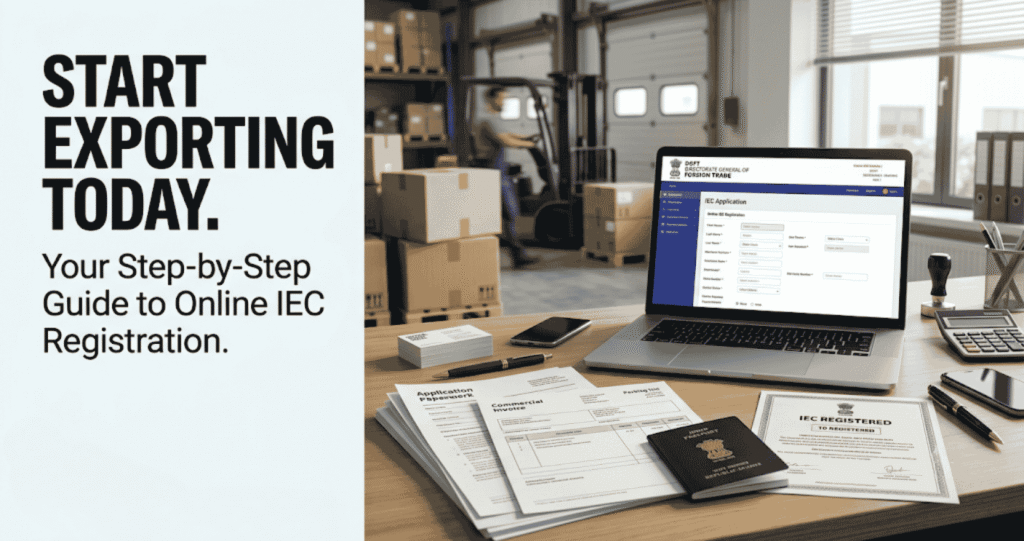
5 Steps to IEC Registration Online (And the One Mistake That Delays It) 5 Steps to IEC Registration Online (And the One Mistake That Delays It) When you start planning to start or expand your business internationally, here’s something most first-time exporters don’t really expect: the number of licenses they are looking for is already sitting in their PAN card number itself . Since IEC of your company was linked directly with the PAN, the registration itself is a very short online form with few signing online & documents submission, not a separate license to chase. What actually takes not more than 1 hour can be completed within fifteen-minute nearby if you process it in one go. The task into a two-week wait is almost never the DGFT portal — it can be only if by any chance a mismatched address proof or a rushed field that forces the application back to square one. If you’re planning to export from India — finished goods, raw material or a service contract — IEC Registration is the first document customs, your bank and DGFT will ask for. Without it, there’s no shipping bill, no foreign remittance credit and no access to export incentive schemes as well. The process is fully online, the government fee is a flat ₹500 and DGFT typically clears a clean application in 1 to 3 working days. This guide covers who needs an IEC, the exact portal steps, which documents actually get accepted, what it costs and where applications usually get stuck. Who Needs an IEC and Who can process without this as well Any individual or business — that can be proprietorship, partnership, LLP or Pvt Ltd company — that wants to import goods into India or export goods and services out of India needs an IEC. This includes manufacturers shipping their own products, traders sourcing from overseas suppliers and service providers billing international clients who need it for foreign remittance purposes. A few categories are exempt: government departments and ministries and individuals importing or exporting for personal use with no commercial angle. Everyone else — including MSMEs shipping a single trial order — needs IEC registration before the first consignment moves. The DGFT IEC Registration Process, Step by Step Register on the DGFT portal. Go to DGFT’s IEC Profile Management page, choose “Register as Importer/Exporter,” and verify your identity with PAN, email and mobile OTP. Log in and start a new IEC application. From the dashboard, select Importer Exporter Code (IEC) → Apply for IEC. Fill in firm and bank details. Enter the legal entity name exactly as it appears on your PAN, business address and bank account for the cancelled cheque upload. Upload documents and pay the fee. Scan documents as PDFs (usually capped at 5MB each), then pay the ₹500 government fee through net banking, card or UPI. E-sign and submit. Complete the application with a digital signature or Aadhaar-based e-sign, then submit for DGFT review. Once submitted, DGFT verifies the application and issues the e-IEC certificate, which you download directly from the portal. Documents That Actually Get Accepted DGFT rejects applications more often for formatting than for eligibility. The documents that typically clear review: PAN card of the individual or company. Aadhaar card or passport for identity verification. Cancelled cheque or bank certificate matching the applicant’s name. Address proof for the business premises — rent agreement, electricity bill or property document, all recent and legible. Certificate of incorporation or partnership deed, where applicable. The recurring rejection reason isn’t a missing document — it’s an address proof that doesn’t match what’s typed into the form or a scan that’s too low-resolution for verification. IEC Registration Fees and Timeline The government fee is ₹500, paid once, non-refundable. There’s no renewal fee, because IEC has lifetime validity. DGFT typically issues the e-IEC certificate within 1 to 3 working days once documents are in order; factor in a few extra days if you also need an AD Code registration with your bank before your first shipment moves. One consultant we worked with recently reviewed a Pune-based engineering exporter’s export documentation and found the delay wasn’t the IEC application at all — it was a shipment held up over an HSN code mismatch between the invoice and the shipping bill, a completely separate compliance step that catches new exporters off guard right after IEC is in hand. Table of Contents https://youtube.com/shorts/YnV4gEc72jc?si=vdNbXAYkCv5aNoFU Common Mistakes to Avoid New applicants tend to repeat the same handful of errors. Watch for these: Entering a business name that doesn’t exactly match PAN records Uploading address proof under an old office address after a move Skipping the mandatory annual update, which DGFT requires every year between April 1 and June 30 to keep the IEC active Assuming IEC alone is enough — customs clearance also needs AD Code registration and, for many categories, RCMC Missing the annual update window is the most common reason an otherwise valid IEC gets deactivated months later, often discovered only when a shipment is stuck at the port. What Happens After You Get Your IEC IEC registration is the entry ticket, not the whole journey. Exporters still need an AD Code registered with their bank for foreign remittance, ICEGATE registration for customs filing and — depending on the product — an RCMC from the relevant export promotion council. Treating IEC as the finish line is where many new exporters lose momentum in their first shipment. How Exim Federation can support you Exim Federation works with manufacturers, startups, MSMEs, and aspiring exporters who need more than general information. The focus is on understanding the business and then creating a practical action plan. Depending on your requirement, support may include: Export Business Setup: Understanding the registrations, documents, and operational requirements. Product Nexus Reports: Studying suitable markets and buyer opportunities for a selected product. Export Strategy: Planning product positioning, market selection, pricing, buyer targeting, and shipment execution. Import Export Consultancy: Receiving practical guidance while implementing the process. Export Consultancy vs Training:
How to Start Export Business in India Without Costly Mistakes
Export Roadmap for Beginners: Start Your Export Business the Right Way Many people believe that starting an export business only requires finding a foreign buyer and sending products abroad. In reality, an export order can become a costly problem if the product, buyer, documents, pricing, payment terms, and shipment process are not planned properly. This is why an export roadmap for beginners is important. It gives you a practical sequence to follow before you invest money, promise delivery, or accept your first international order. What export business really involves Exporting is not simply selling an Indian product in another country. It is a complete business process involving market research, product selection, compliance, pricing, buyer communication, logistics, payment collection, and after-sales support. Before starting, an exporter should clearly understand: Which product has demand in the selected market. Whether the product meets the destination country’s quality and labelling requirements. What HS code applies to the product. How much the product will cost after packaging, freight, insurance, customs-related expenses, and other charges. Which payment method will reduce the risk of delayed or non-payment. Which documents are required before and after shipment. For commercial exports from India, the Importer Exporter Code, commonly called IEC, is a key business identification number issued by the Directorate General of Foreign Trade. The official DGFT guidance states that businesses intending to import or export generally need an IEC. You can review the official DGFT IEC guidance before beginning the registration process. cite Many people believe that starting an export business only requires finding a foreign buyer and sending products abroad. In reality, an export order can become a costly problem if the product, buyer, documents, pricing, payment terms, and shipment process are not planned properly. This is why an export roadmap for beginners is important. It gives you a practical sequence to follow before you invest money, promise delivery, or accept your first international order. Many people believe that starting an export business only requires finding a foreign buyer and sending products abroad. In reality, an export order can become a costly problem if the product, buyer, documents, pricing, payment terms, and shipment process are not planned properly. This is why an export roadmap for beginners is important. It gives you a practical sequence to follow before you invest money, promise delivery, or accept your first international order. What export business really involves Exporting is not simply selling an Indian product in another country. It is a complete business process involving market research, product selection, compliance, pricing, buyer communication, logistics, payment collection, and after-sales support. Before starting, an exporter should clearly understand: Which product has demand in the selected market. Whether the product meets the destination country’s quality and labelling requirements. What HS code applies to the product. How much the product will cost after packaging, freight, insurance, customs-related expenses, and other charges. Which payment method will reduce the risk of delayed or non-payment. Which documents are required before and after shipment. For commercial exports from India, the Importer Exporter Code, commonly called IEC, is a key business identification number issued by the Directorate General of Foreign Trade. The official DGFT guidance states that businesses intending to import or export generally need an IEC. You can review the official DGFT IEC guidance before beginning the registration process. cite Why an export roadmap is important A roadmap helps you avoid making decisions in the wrong order. For example, some new exporters first search for buyers and only later discover that their product requires a special certificate or cannot be shipped under the quoted price. A planned approach helps in four important ways: It reduces avoidable mistakes: You know which registrations, documents, and approvals must be completed first. It improves pricing: Export pricing is calculated after considering the complete cost, not just the factory or purchase price. It supports better buyer communication: You can answer questions about specifications, delivery, packaging, payment, and documents with confidence. It protects working capital: A clear plan helps you decide how much money is required for samples, inventory, packaging, freight, and credit periods. India’s MSME sector remains highly relevant to international trade. Government-reported figures indicate that MSMEs contributed approximately 48.58% of India’s exports and about 35.4% of manufacturing. cite These figures show the opportunity, but opportunity alone does not guarantee success. Preparation and execution matter just as much. How to manage the export process The export process becomes easier when it is divided into manageable stages. 1. Select the right product and market Do not select a product only because it is available locally or because another exporter is selling it successfully. Study the demand, competition, target buyers, pricing, regulations, and shipping feasibility. A Product Nexus Report can be useful at this stage because it connects product information with possible markets, buyer segments, competition, and commercial opportunities. The objective is not to choose a country based on guesswork. It is to shortlist markets where your product has a realistic chance of selling. 2. Complete the business setup Your business should be ready to receive and make international payments, issue proper invoices, and manage export records. Depending on your business structure and product, the setup may include: Business registration and PAN. GST registration, where applicable. IEC from DGFT. A current account with an authorized dealer bank. AD code and customs-related registrations, as applicable. RCMC or product-specific registration, where required. Product certificates, testing reports, or licenses. The exact requirements may differ for spices, food products, pharmaceuticals, engineering goods, textiles, cosmetics, and other categories. Therefore, a document checklist should be prepared according to the product and destination market. 3. Build a practical export strategy A good export strategy answers basic commercial questions before you approach buyers: Who is the ideal buyer? Which countries should be targeted first? What quantity can you supply consistently? What is your minimum profitable order size? Which Incoterm will you quote? Will you accept advance payment, a letter of credit, or another arrangement? How will you handle samples and quality claims? For instance,
Export Registration Checklist: 9 Registrations Before Your First Shipment
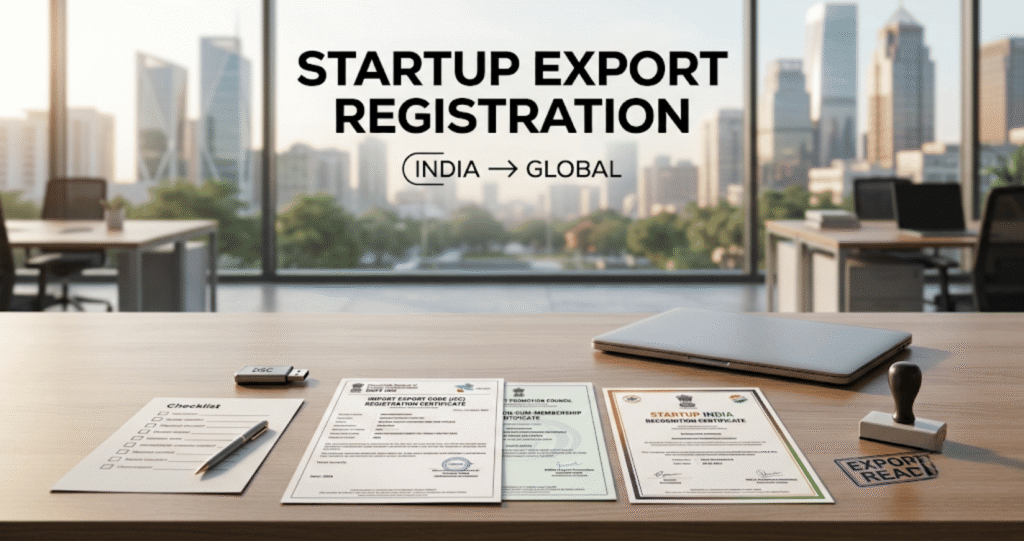
Export Business Registration: What Startups Need Before Taking Orders Most of the startups assume that getting an Importer Exporter Code is the only step required before sending goods for exports. That assumption can create easily avoidable problems. An IEC is essential, but exporters may also need GST registration, LUT, RCMC, ICEGATE access, AD Code registration and product-specific approvals. Lets understand The right registration depends on your business structure, product, destination country and export model. If you are preparing for your first international order, this export registration checklist will help you identify the main registrations and documents to arrange in India. It separates registrations that are commonly required from approvals that apply only to particular products. The usual starting point is a legally established business, PAN, a business bank account and an IEC from the Directorate General of Foreign Trade. DGFT describes IEC as a key identification number that is mandatory for export from India, subject to applicable exceptions. DGFT IEC Profile Management The checklist below is designed for startups and MSMEs that want to avoid last-minute documentation issues. 1. Set up the business entity Before applying for export-related registrations, decide how the business will operate. A startup may export as a proprietorship, partnership firm, LLP, private limited company or another permitted structure. Keep these basic records ready: PAN of the business or proprietor. Proof of constitution, such as a partnership deed, certificate of incorporation or registration certificate. Business address proof. Current account in the business name. Active email address and mobile number. Digital signature or Aadhaar-based authentication, wherever required. A cancelled cheque or bank certificate showing the firm’s name. The name and address should remain consistent across PAN, GST, bank records, IEC and invoices. A mismatch may not always stop an application, but it can create verification questions and shipment delays. 2. Apply for the IEC The Importer Exporter Code is the core registration in most export transactions. The application is submitted online through the DGFT portal. For the IEC application, DGFT guidance refers to documents such as proof of establishment, address proof and proof of the firm’s bank account. The portal also validates important firm and PAN details. DGFT IEC application guidance. 3. Complete GST registration and choose the export route GST registration is an important part of export business registration, particularly when the business intends to claim export-related tax benefits or conduct regular commercial exports. Exports are generally treated as zero-rated supplies under the IGST framework. A registered exporter may usually choose between: Exporting under a Letter of Undertaking, commonly called an LUT, without payment of integrated tax. Exporting on payment of integrated tax and applying for a refund, where applicable. An exporter using the LUT route must furnish the LUT before making the relevant export supplies. The GST portal provides the path Services → User Services → Furnish Letter of Undertaking (LUT). GST portal LUT guidance GST and LUT checklist GST registration certificate. Correct HSN or service classification. Exporter’s GSTIN on invoices. LUT filed for the relevant financial year, when using that route. Copies of export invoices and shipping documents. Reconciliation between GST returns, invoices and shipping bills. A common misconception is that every exporter must pay IGST first. In practice, the suitable route depends on cash flow, eligibility, transaction structure and refund planning. Discuss the method with a qualified tax professional before issuing the first invoice. 4. Obtain RCMC when your product or benefit requires it A Registration-Cum-Membership Certificate, or RCMC, links an exporter with the relevant Export Promotion Council, commodity board or development authority. RCMC is not automatically the same for every product. Your main product and its ITC-HS classification help determine the appropriate authority. DGFT states that RCMC is issued by authorized EPCs, commodity boards, development authorities or other competent organizations, generally for five financial years. DGFT e-RCMC service For agricultural and processed food products covered by APEDA, exporters can apply for e-RCMC through the DGFT portal after obtaining the IEC. APEDA began issuing RCMC through the DGFT portal from 17 July 2023. APEDA RCMC procedure RCMC checklist Valid IEC. Product details and ITC-HS code. GST and PAN information. Business constitution documents. Bank details. Relevant EPC or commodity board selection. Membership fee and supporting documents. RCMC may matter when you apply for certain export authorisations, incentives or council-specific services. Confirm the requirement before relying on it for a particular benefit. 5. Register with customs and your bank IEC and GST registration do not, by themselves, complete the customs setup. Exporters should also prepare access to customs filing systems and coordinate with the authorised dealer bank. ICEGATE is the customs electronic platform used for several customs-related services. Its guidance states that exporters can register through the portal’s registration module. The bank-related step commonly involves AD Code registration. The AD Code identifies the authorized dealer bank branch handling foreign exchange transactions for the exporter. ICEGATE provides an advisory for registering the AD Code bank account through the exporter’s profile. ICEGATE AD Code advisory Customs and banking checklist ICEGATE user registration. Current account linked to the export business. Authorized dealer bank branch confirmation. AD Code letter or bank-provided details. Bank account mapping at the intended port. Shipping bill and drawback or refund details reviewed with the customs broker. This step deserves attention before cargo reaches the port. A bank or port mapping issue can affect the processing of export benefits and create operational delays. 6. Check product-specific approvals There is no single registration that makes every product export-ready. The product category may trigger additional licences, certificates, testing and labelling conditions. Examples include: Food products: FSSAI licence or registration, as applicable. Agricultural and processed products: APEDA or another commodity authority, depending on the product. Marine products: Marine Products Export Development Authority requirements. Pharmaceuticals and medical products: applicable drug or health authority permissions. Chemicals: safety documents, restricted-item permissions or destination-specific compliance. Handicrafts, textiles or engineering goods: buyer, destination and council-related requirements. Plant products: phytosanitary certificate where required. Animal products: veterinary or health certificates where required. FSSAI provides a
India Targets 5% Global Toy Share: What Exporters Should Notice Now
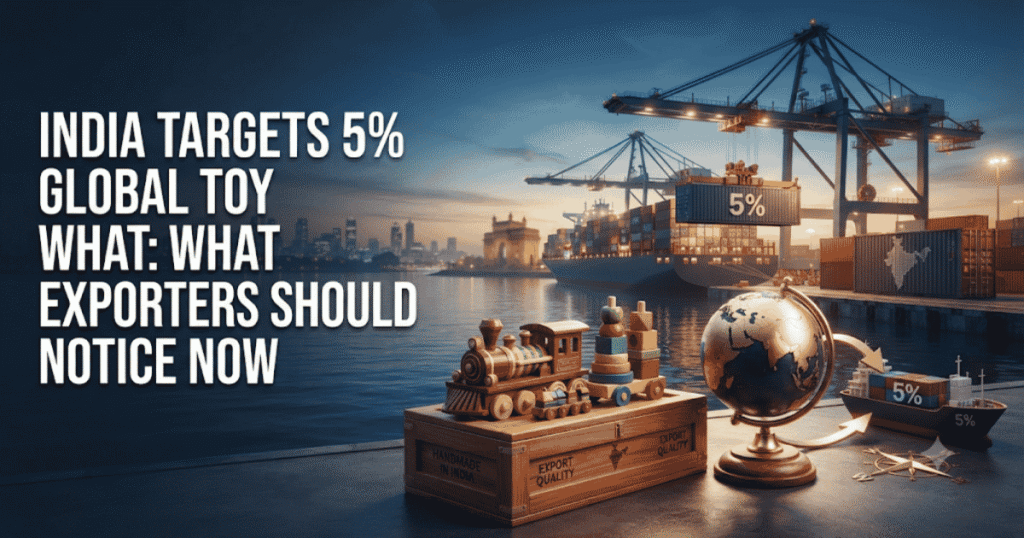
India Targets 5% Global Toy Share: What Exporters Should Notice Now For years, India was seen mainly as a toy importer, not a serious global supplier. This picture is changing rapidly now. India’s toy export push is now tied to a national goal of reaching 5% of the global toy market by 2032, which is a big ambition for a sector that has only recently built stronger manufacturing depth. Introduction This shift matters a lot because toys are not a small size industry anymore. They touch manufacturing, compliance, design, packaging, logistics and brand building everything at once. Mainly for exporters, manufacturers and MSMEs, this is a useful signal: the toy sector is moving from low-value trade to a more structured export opportunity. In this article, we will look at why the target matters, what is driving growth, where the practical opportunities are and what businesses should avoid if they want to benefit from India’s toy export push. Reference – [pib.gov] Why this matters now The biggest change is policy support. India has tightened quality standards, reduced unsafe imports and pushed domestic production through the Toys (Quality Control) Order and related industry measures. That matters because toy buyers in export markets care about safety, consistency and documentation as much as price. Reference – [bis.gov] The other change is momentum. Government statements in recent years show a clear rise in exports and a steady shift toward net exporter status. The current opportunity is not just about more volume. It is about building a better-positioned supply base for global buyers. What the trend shows The toy sector is one of the clearest examples of how policy and industry discipline can change trade performance. Official government releases have noted sharp export growth and lower dependence on imports over recent years, while BIS certification has made compliance a central part of the business model. A few signals stand out for the 5% plan: – Indian toy exports have grown strongly in recent years. – Toy imports have fallen, which helped local manufacturers gain room in the domestic market. – BIS certification is now a real entry barrier, especially for weak or informal suppliers. – FTAs and trade agreements are creating better access in some markets. This is why many exporters now see toys as more than a domestic manufacturing story. It is becoming an export-ready category with policy tailwinds. Practical opportunities for exporters The opportunity is strongest for businesses that can handle both compliance and consistency. Toys are not a “cheap product, fast sale” category. They need product safety, packaging quality, labeling discipline and repeatable sourcing. That is exactly where many new exporters struggle, but also where prepared MSMEs can stand out. Good entry points include: – Educational toys and learning-focused products. – Wooden toys and eco-friendly categories. – Non-electronic toys with simpler supply chains. – Private-label manufacturing for overseas distributors. – Small-batch export orders for niche retailers. For example: A small manufacturer in India may start with a limited wooden toy range, secure BIS compliance, improve packaging and then approach a distributor in the UK or UAE. The first order may be modest, but the real win is building a compliant export process that can scale. That is more sustainable than chasing one large order without systems. Common mistakes to avoid Many new exporters assume the toy business is mostly about design or pricing. In reality, the winning formula is compliance plus reliability plus market fit. If one of these is missing, orders can stop quickly. Avoid these mistakes: – Treating BIS compliance as an afterthought. – Assuming all toys can move across markets without labeling changes. – Ignoring age-group, material and safety documentation. – Overestimating demand without checking buyer norms. – Copying trending products without understanding risk and margin. A common misconception is that training alone is enough. It is useful, but implementation matters more. Businesses usually need help in selecting the right products, pricing them properly and preparing export-ready systems. That is where consultancy often gives faster results than generic guidance. Practical Action roadmap for msme’s If you are planning to enter this segment, start with a practical roadmap: Choose one toy category first. Do not launch with too many SKUs. Check compliance early. BIS and product standards should be part of product planning. Study your target market. Different countries expect different packaging, labeling and buyer behavior. Build a buyer profile. Wholesalers, distributors and private-label buyers need different pitches. Prepare export documents. Keep quality records, test reports and product specs ready. Test small before scaling. One dependable market is better than five uncertain ones. For exporters, India’s toy export push is not a headline to admire from a distance. It is a signal to prepare your product, paperwork and distribution strategy now. Key Takeaways – India’s toy sector is moving from import dependence toward export expansion. – Policy support and BIS compliance are shaping the market. – The 5% global share goal is ambitious and will need execution, not just policy intent. – Export opportunities are strongest in compliant, quality-driven toy categories. – MSMEs can benefit if they focus on product selection, documentation and buyer readiness. – Common mistakes include weak compliance, poor packaging and unclear market targeting. – Consultancy-led implementation can often work faster than theory-heavy training. Conclusion If you are exploring toys as an export Import sector, Exim Federation can help with practical guidance through import-export consultancy, Product Nexus Reports and export business setup support. For business discussions, contact +91-9403733464 or visit [www.eximfederation.in](https://www.eximfederation.in). Contact: Exim federation By Dattasa environment +91-9403733464, website – www.eximfederation.in. FAQ -Frequently Asked Questions 1. Is India really becoming a global hub for the toy export market? Yes, the direction is clearly positive. Government releases and industry reporting show higher exports, lower imports and stronger domestic manufacturing capacity. The important point is that this is still a developing opportunity, not a fully mature one. Businesses that enter now with compliance and quality systems can gain an early advantage. 2. Why is BIS compliance so important for toys export &
US-India Trade Deal: What Exporters Need to Know Now
US-India Trade Deal: What Exporters Need to Know Now The US-India trade deal is not just a policy headline. For exporters, it can change pricing, margins, product focus and market entry plans faster than many business owners expect. The real mistake is waiting for the final signature before preparing. By then, competitors may already be fixing their export strategy and talking to buyers. The recent discussion around the US-India trade deal has brought fresh attention to one of India’s most important export markets. India and the US have already been advancing bilateral trade talks through formal negotiation steps and official updates show that the process is active, not theoretical. For manufacturers, startups and MSMEs, this matters because even partial tariff changes or market-access shifts can influence demand, sourcing and buyer interest. In this article, we will break down what the deal means in practical terms, what exporters should watch and how to prepare without making guesses. The focus is simple: make better business decisions now, not after the market has already moved. Why this matters now The US is one of India’s largest trade partners and official trade data shows the scale is already substantial. That means any change in duties, documentation or market access can have a real effect on export planning, especially for sectors that depend on price competitiveness. The current negotiation process also suggests that businesses should track developments closely rather than treating them as distant policy news. One common misconception is that only large exporters benefit from trade deals. In reality, MSMEs often gain the most when they are ready early, because they can move faster in niche categories, private-label supply and buyer-led sourcing. A trade deal does not automatically create export success, but it can remove friction for businesses that are already prepared. What the data shows Official and authoritative sources show that India-US trade has remained active and strategically important. The U.S. Trade Representative’s India page notes strong trade volumes and ongoing focus on tariff and non-tariff barriers, while the White House has described the current framework as part of a broader bilateral trade agreement process. Reuters also reported that both sides were working toward a formal accord, with implementation timelines under discussion. For exporters, the important lesson is not the headline number itself. It is the direction of travel. When negotiations focus on market access, customs facilitation and tariff reduction, exporters should start evaluating product categories that can become more competitive if the rules improve. Lets understand with an example One of our consultancy client Pune-based engineering manufacturer MSME exporting sterling machines & also its components to the US currently face margin pressure because of freight, compliance costs and buyer negotiation. If a trade framework lowers trade friction or improves tariff treatment, that company may not need a new product line. It may simply need better HS-code planning, updated documentation and sharper buyer pitch. That is where preparation matters more than panic. Practical opportunities for exporters and MSME’s The biggest opportunity is to review where your product sits in the US value chain. If you are in engineering goods, chemicals, electronics, textiles, processed foods or supplier segments linked to larger US buyers, the trade environment deserves attention. Even before any final agreement, buyers often start asking suppliers about capacity, compliance, lead times and price stability. Exporters should focus on three practical actions: Identify products with repeat demand in the US market. Check where your pricing becomes weak after duty and logistics. Build buyer-ready documentation, including product specs, certifications and consistent labeling. This is also the right time to study competitor positioning. If another exporter is already using a more efficient sourcing model or better compliance structure, they may win the same order even without offering the lowest base price. https://youtube.com/shorts/2hZ11FBRZOQ?si=QgUNzX_5Oox2xL_z Common mistakes exporters and even you also should avoid The first mistake is assuming the deal will instantly remove all barriers. Trade agreements usually come with phased implementation, product-specific terms and political conditions. Businesses that wait for a dramatic overnight shift often lose time. The second mistake is focusing only on tariff reduction. In export business, buyers care about reliability, documentation, shipment consistency and claim handling. A lower duty helps, but it does not fix poor communication or weak operational discipline. The third mistake is ignoring product-level strategy. Not every exporter should rush toward the US market just because headlines are positive. The better approach is to check whether your product has a clear buyer need, healthy margin and manageable compliance load. Practical Action steps for exporters Start with a simple readiness check. Review your top products, target buyers, certifications and landed cost structure. If your product is already selling in the Gulf, Europe or Southeast Asia, the US can be a logical expansion market, but only if your pricing and compliance are strong. Use this five-step roadmap: Map your current export products against US demand. Calculate landed cost with realistic duty and freight assumptions. Review packaging, labeling and compliance gaps. Shortlist potential US buyers or importers. Track official trade updates and adjust your pitch accordingly. The US-India trade deal should be treated as a business signal, not just a news event. Exporters who prepare early can turn policy movement into real commercial advantage. Key Takeaways The US-India trade deal is a serious business signal for exporters, not just a news headline. India and the US are actively working through a broader bilateral trade agreement process. MSMEs can benefit if they prepare early with pricing, compliance and buyer readiness. Tariff changes matter, but they are only one part of export success. Product-level planning is more important than reacting emotionally to news. Exporters should review landed cost, documentation and target market fit now. Early preparation can create an advantage before competitors move. Conclusion The US-India trade deal could open useful opportunities, but only for businesses that prepare with clarity. Exporters should look beyond the headline and focus on product fit, compliance, pricing and buyer readiness. That is how a policy update becomes a
India-UK Car Import Quota Rules Explained: A Practical Guide for Businesses

India-UK Car Import Quota: What Businesses Need to Know The India-UK car import quota is not just another customs update. It is a reminder that trade policy can change buying decisions, distributor plans, and margin calculations much faster than many businesses expect. India’s DGFT has opened applications for quota allocation under the India-UK CETA for calendar year 2026, with the first phase covering 9,316 passenger vehicles and applications open from July 21 to August 4. UK passenger cars covered under India-UK trade pact quotas For importers, dealers, and auto businesses, the real question is not whether the India-UK car import quota exists. The real question is whether you understand the quota rules well enough to use them without wasting time, money, or compliance effort. Under the India-UK CETA, India has set a structured tariff-rate-quota system for UK vehicle imports, and the first year includes fixed allocations by vehicle category. This matters because quota-based imports are very different from ordinary imports. You need the right documents, the right counterparties, and the right timing. In this article, you will see what the quota covers, how the process works, where businesses can benefit, and which mistakes to avoid. Why this matters now The key change is that vehicle import decisions are now tied to a formal quota and a concessional duty structure under CETA. According to DGFT, only OEMs and their authorised dealers or channel partners can apply for tariff rate quotas, and the application must be backed by a pre-purchase agreement from a UK-based OEM. This is important for three reasons: It limits applications to serious, traceable market participants. It pushes businesses to plan inventory and pricing earlier. It makes compliance part of the commercial strategy, not just a back-office task. A common misconception is that lower duty automatically means easy savings. In reality, quota access, origin proof, and allocation timing decide whether the benefit is actually available. What the quota covers The first-year allocation has been split across passenger vehicle categories, and the allocation is not flat across all cars. Reported quota blocks include 2,329 units for cars up to 1,500 cc, 2,329 units for petrol above 1,500 cc but below 3,000 cc and diesel above 1,500 cc but not exceeding 2,500 cc, and 4,658 units for larger petrol and diesel vehicles. The concessional duty also varies by category. For some vehicles, the basic customs duty drops from 66% to 50%, while larger-engine vehicles reportedly see duty reduced from 110% to 30% under quota conditions. For businesses, this means one thing: category selection matters. A wrong assumption about engine capacity, fuel type, or quota band can change landed cost calculations completely. Practical opportunities for importers The biggest opportunity is not for speculative buyers. It is for businesses that can align sourcing, documents, and sales commitments before the quota is exhausted. DGFT has said the cumulative quota allocation will be monitored, and once the annual limit is reached, no additional TRQ certificates will be issued. That creates real openings for: Premium car distributors planning UK-origin inventory. Authorised channel partners with formal OEM backing. Dealers building a niche in specific engine-size or premium segments. Buyers who can use early allocation to improve margin predictability. Mini case study: a mid-sized auto importer in India planning a premium British model cannot rely on “we will apply later.” If the quota closes early, the business may lose the lower-duty window entirely. In that case, the gap is not just administrative; it becomes a pricing and sales problem. Common mistakes to avoid The first mistake is treating quota as a standard import license. It is not. The DGFT process is tied to a specific TRQ structure and a defined application window for calendar year 2026. The second mistake is ignoring origin and documentation. Importers must produce a valid Certificate of Origin issued by the authorised UK authorities at the time of import. Without that, the concessional duty benefit can fail at the customs stage. The third mistake is assuming all vehicle types are treated the same. Reports show the policy is category-based, and the rules differ by engine size, fuel type, and quota band. Action steps for businesses If you are considering participation, the sequence should be practical and fast: Confirm whether you are eligible as an OEM, authorised dealer, or channel partner. Collect the UK OEM pre-purchase agreement and supporting trade documents. Map each model to the correct quota category and duty band. Check the application window and file before the quota gets consumed. Build landed-cost sheets with and without concessional duty so your pricing stays realistic. One official reference point worth tracking is the DGFT public notices page, which hosts the TRQ-related notices for India-UK CETA. Key Takeaways India has opened applications for the India-UK car import quota for calendar year 2026. The first phase covers 9,316 passenger vehicles. Only OEMs and their authorised dealers or channel partners are eligible to apply. A UK OEM pre-purchase agreement is required for the TRQ application. Duty benefits depend on vehicle category, engine size, and quota band. Once the quota is exhausted, no more TRQ certificates are issued for that year. Documentation and timing matter as much as pricing. Conclusion The India-UK car import quota is a good example of how trade opportunities reward preparation, not guesswork. Businesses that understand quota timing, documentation, and duty structure will be better placed to make informed import decisions under the India-UK CETA. The phrase India-UK car import quota may sound narrow, but for the right importer it can shape pricing, sourcing, and sales strategy in a meaningful way. Exim Federation can support this through import-export consultancy and Product Nexus Reports for businesses evaluating practical trade moves. For guidance, contact +91-9403733464 or visit www.eximfederation.in. FAQ -Frequently Asked Questions 1) Who can apply for the India-UK car import quota? Only OEMs and their authorised dealers or channel partners are eligible to apply for the tariff rate quota under the DGFT process. The application also needs a UK OEM pre-purchase agreement showing the
Why ASEAN, Africa Are Now Driving India’s Export Boom — And How MSMEs Can Tap These Markets
Why ASEAN and Africa Are Now Driving India’s Export Boom — And How MSMEs Can Tap These Markets ASEAN – Africa lead India’s export growth in first two months of FY-27 Most Indian exporters still think “USA and Europe” when they hear the word exports, but the data for FY-27 tells a very different story. In the first two months of the year, ASEAN and African economies contributed the biggest share to India’s export growth, with shipments to these regions rising far faster than traditional Western markets. If you are still building your plan only around NAFTA and Europe, you are already late to the party. Ministry of Commerce data shows that ASEAN, Africa led India’s export growth in the first two months of FY-27 with exports to ASEAN jumping approximately 66.9% and to Africa 53.1% year-on-year in April–May. Together, these regions added over USD 7.6 billion in extra exports, while NAFTA and Europe grew much more modestly. For a new exporter or MSME, this is not just “big picture news” — it directly affects where you should focus your energy, product research and relationship-building. In this article, we’ll break down what this shift means, which opportunities are opening up, common mistakes to avoid and practical steps to align your export strategy with this new reality. Why ASEAN – Africa Are Suddenly comes at Centre Stage When it comes to the India’s exports of goods and services in April–May FY-27 are estimated at USD 162.69 billion overall, with regions outside North America and Europe now more than half of total exports. Within this time period, ASEAN and Africa lead India’s export growth in the first two months of FY-27 by contributing the largest incremental gains. Key data points you should know: Exports to ASEAN: Up 66.9%, from USD 6.3 billion to USD 10.5 billion. Exports to Africa: Up 53.1%, from USD 6.3 billion to USD 9.6 billion. Combined additional exports from these regions: Over USD 7.6 billion versus last year’s same period. At the same time, NAFTA remained India’s largest destination but grew only 2.6% and Europe 4%, showing slower momentum compared to these emerging markets. For MSMEs, the message is simple: growth is shifting where competition is relatively lower and demand is rising faster, especially in sectors like engineering goods, pharmaceuticals, consumer products, food items and petroleum products. Common Misconception: “Only Western Markets Are Worth Targeting” A big misconception among new exporters is that serious export success is possible only if you break into the US or EU first. In reality, the commerce ministry’s data clearly shows ASEAN, Africa lead India’s export growth in the first two months of FY-27, while Western markets are growing but not driving the expansion. Why this mindset of exporters specially for the new business is risky now: Western markets are mature with high competition and tighter regulatory requirements. Many ASEAN and African economies are in a phase of rapid infrastructure and consumption growth, creating demand for a wide range of Indian products. Trade relationships with several of these countries are strengthening through ongoing negotiations and cooperation. Training programs often keep talking about “US, UK, EU” because they sound aspirational. The practical truth is that implementation-focused export consultancy aimed at ASEAN and African markets can deliver quicker wins and more sustainable growth for MSMEs. https://youtube.com/shorts/2hZ11FBRZOQ?si=QgUNzX_5Oox2xL_z Where Exactly Are the Opportunities? To make this more firm & workable lets understand this with an example, consider a small engineering goods manufacturer in Pune producing pumps and basic agricultural equipment. In the past, they tried to target Europe but struggled with certifications, high compliance costs and long sales cycles. In early FY-27, they shifted strategy after seeing that ASEAN, Africa led India’s export growth in the first two months of FY-27, focusing on markets like Tanzania, South Africa and Sri Lanka. Step-by-step, they: Identified demand for affordable irrigation equipment and agro machinery in East Africa through trade data and embassy reports. Aligned their product range to local needs (simple, rugged equipment rather than highly automated systems). Worked with an implementation-focused consultant to build a Product Nexus Report — mapping their product SKUs to HS codes, suitable target markets and indicative pricing bands. Leveraged trade fairs and B2B platforms focusing on Africa and ASEAN instead of general global platforms. Within 12–18 months, their export share from ASEAN and Africa crossed what they previously attempted in Europe, with fewer regulatory hurdles and more responsive buyers. This is the kind of pivot many MSMEs can make when they read the data correctly and design strategy around it. How Can a New Exporters Can Align Their Strategy with the FY-27 Shift If you are planning to enter exports or expand them, here is a practical roadmap based on the current pattern where ASEAN, Africa lead India’s export growth in the first two months of FY-27. Start with data, not assumptions.Use official commerce ministry and DGFT data to see which product categories are growing in ASEAN and African markets. If a regulation or detailed breakdown is not clearly published, mark it as [VERIFY-] in your internal notes instead of guessing. Prioritize 3–5 target countries.Do not target “ASEAN” or “Africa” as one big block. Shortlist specific countries like Singapore, Tanzania, South Africa, Sri Lanka, or Kenya based on sector demand and logistics feasibility. Develop a Product Nexus, not just a product list.Map your products to HS codes, competitor offerings, local price points and buyer segments. This turns a broad “I want to export” wish into a clear export strategy for ASEAN and Africa in line with current trends. Focus on implementation, not only training.Many businesses attend generic export training and then get stuck at documentation, buyer discovery and pricing. Consultancy that walks with you through HS code alignment, documentation and market entry often produces faster, measurable results. Plan logistics and payment terms early.For new destinations, understand freight routes, transit times, insurance and realistic payment protection methods (LC, advance, mixed terms) before quoting. Emerging markets can be highly rewarding but require
India – EU Strengthen Strategic Partnership at 3rd TTC — New Opportunities in Tech and Trade
India – EU Strengthen Strategic Partnership at 3rd TTC — New Opportunities in Tech and Trade India – EU Strengthen Strategic Partnership at 3rd TTC India-EU Trade and Technology Council is no longer just a diplomatic forum now. With the latest meeting, India and the EU are signaling that trade, technology and supply chains will now move together not separately like it has to be previously. Especially for exporters, manufacturers and startups looking for the change in the eco system. It means new possibilities & openings in advanced manufacturing, digital trust, clean energy and tech collaboration. Introduction The phase of India – EU strengthening their strategic partnership at 3rd TTC is more than a headline for businesses. It mainly reflects a practical shift in how India and the European Union want to work together across business, technology and trusted trade partnership. The immediate question that may arise for business owners is simple: what does this mean in real terms of business development expansion? The answer matters because the EU is one of the most valuable & high paying markets for Indian exporters, but it is also one of the most demanding. Compliance, product standards, sustainability expectations and supply chain reliability all matter. In this article, you will see what was discussed, why it matters and where Indian businesses can find opportunities. What the TTC means The India – EU strengthened strategic partnership at 3rd TTC shows that both sides are treating the TTC as a working platform, not a symbolic one. According to the reports, the both sides are focusing on artificial intelligence, semiconductors, quantum technologies, clean energy and resilient supply chains. For businesses, that means the partnership is moving into areas where commercial value is created through collaboration, standards and trusted ecosystems. It is not only about government-level agreements. It can shape procurement, research, innovation funding, supplier selection and technology partnerships. Why exporters should care Indian exporters often think EU opportunities are limited to finished goods shipments. That is a common misconception. In reality, this partnership can influence broader business categories such as component supply, co-development, testing, certification and technology-enabled services. The key commercial signals are: Stronger focus on trusted and resilient supply chains. More co-operation in clean technologies and green manufacturing. Greater interest in semiconductor ecosystems and advanced manufacturing. Better scope for digital trade support, including digital trust services. If your business serves electronics, automotive, renewables, industrial equipment, or engineering goods, this is worth watching closely. Even service providers that support export operations may benefit from new cross-border standards and partnerships. Where the opportunities are The most practical opportunities are likely to appear in sectors where India already has capability and the EU is actively looking for reliable partners. The TTC discussions reportedly covered AI, semiconductors, clean energy, hydrogen-related work, battery recycling and startup cooperation. That opens room for Indian companies in these areas: Food & FMCG sector Electronics and semiconductor supply chains. Clean-tech components and energy efficiency products. EV charging and testing ecosystem support. Green manufacturing and circular economy solutions. IT, digital compliance and trusted tech services. A useful example is a mid-sized Indian manufacturer that supplies precision parts for EV systems. Earlier, it may have focused only on price and delivery. Now it can position itself around traceability, quality systems and long-term supply reliability, which are exactly the kind of features EU buyers value. Common mistakes to avoid Many businesses hear a positive trade headline and assume exports will automatically rise. That is not how the EU market works. Good policy direction creates opportunity, but real entry still depends on product readiness, documentation, certification and buyer confidence. Avoid these mistakes: Assuming policy news alone will bring orders. Ignoring EU product standards and sustainability requirements. Treating Europe as one uniform market. Waiting until negotiations are complete before preparing. Sending generic sales pitches instead of market-specific offers. The smarter approach is to prepare now. Build product-market fit, create technical data sheets, review compliance and identify target countries and buyer segments before the opportunity window becomes crowded. What businesses should do now The best response to India – EU strengthening strategic partnership at 3rd TTC is preparation. Businesses should use this moment to tighten their export strategy and assess where they fit in the evolving India-EU value chain. A practical checklist: Review product compliance and documentation. Identify which EU countries match your category best. Strengthen your quality, traceability and sustainability story. Build a buyer pitch around reliability, not just pricing. Track official updates on trade and technology cooperation. One important reference point is the European Commission’s TTC update page, which provides official information on India-EU trade and technology cooperation. https://digital-strategy.ec.europa.eu/en/news/eu-and-india-strengthen-strategic-partnership-third-trade-and-technology-council Key Takeaways The India – EU strengthened strategic partnership at 3rd TTC development is focused on trade, technology and security. AI, semiconductors, quantum technologies and clean energy are core cooperation areas. Exporters should see this as a market-preparation signal, not a guarantee of sales. EU buyers will still expect strong compliance, quality and supply reliability. Clean-tech, electronics, EV-related supply chains and digital services may gain the most. Businesses that prepare early will be better placed than those waiting for headlines to turn into demand. Conclusion The message from the 3rd TTC is clear: India and the EU want a deeper, more practical partnership. For exporters and manufacturers, that means opportunity is growing in technology-led and compliance-driven sectors, but only businesses that prepare properly will benefit. The real advantage will go to companies that align products, processes and market strategy with EU expectations. If you want to start & expand your business on an international platform with practical guidance & experts with 8+ years of industry experience on Business setup, market targeting or product-level opportunity mapping, Exim Federation can help through step by step consultancy and Product Nexus Reports. For more details you can connect – : +91-9403-73-3464 visit us- www.eximfederation.in. FAQ -Frequently Asked Questions 1) What is the India-EU Trade and Technology Council? The India-EU Trade and Technology Council is a formal platform where both sides discuss
Why India’s June exports stayed strong even as the trade deficit hit a five-month high
India’s June exports shine through West Asia dark clouds; trade deficit widens to five-month high Why India’s June exports stayed strong even as the trade deficit hit a five-month high India’s June exports shine through even from the West Asia dark clouds; a trade deficit widened to five-month high and this combination says something which needs to pay an attenuation & equally importance as well: strong export numbers do not always mean a comfortable trade picture. Many business owners assume rising exports automatically reduce external pressure, but the equally important parameter in the trade deficit i.e. imports can rise faster and change the story quickly. For exporters, this is not just macroeconomics. It affects pricing, shipping, market choice and the kind of products that stay competitive in uncertain global conditions. Lets understand The latest trade data of the ministry of commerce shows a familiar but important pattern: India’s outbound shipments held up well in June, even as the wider trade deficit expanded. For manufacturers, new exporters and MSMEs. The real question is not whether exports rose. It is why they rose, which sectors from the exports supported them and how West Asia-linked disruptions can still affect margins, freight and delivery timelines. This article breaks that down in simple terms, so you can understand what the numbers mean for your export plans and where the risks sit. What the June data signals India’s merchandise exports rose to about $40.41 billion in June, while the merchandise trade deficit widened to a five-month high of $30.43 billion because imports grew faster. That is the key message behind the headline: export resilience is real, but so is import pressure as well working silently. The broader point is that a healthy export month can still coexist with a weak trade balance if energy, commodities or even the chances of other critical imports becomes costlier. What matters for business owners is the quality of export growth: Some sectors are growing because of rising demand. Some are growing rapidly in the FOMO ( Fear of missing out) because buyers are reordering faster due to supply chain uncertainty. Some sectors are growing just because India is gaining share in markets that are actively diversifying away from riskier sourcing routes. That distinction helps you avoid reading the headline too simply. Why West Asia still matters West Asia remains important because it influences shipping routes, crude prices, insurance costs and also the confidence of buyers. Even when exports do not collapse, the region can create indirect pressure from the International freight volatility and input inflation. That is why a “trade deficit” headline often reflects more than just export performance. It can also reflect costlier imports, especially when crude-linked products move sharply. For exporters, the practical lesson is straightforward: Monitor route risk before confirming delivery commitments. Recheck landed cost assumptions every time freight or fuel moves. Avoid quoting long validity periods when input costs are unstable. Keep alternate shipping options ready for sensitive markets. A common misconception is that geopolitical stress only hurts exporters shipping directly to the affected region. In reality, the shock often spreads through freight, insurance and raw material prices even for exporters selling elsewhere. Which sectors can benefit When exports remain strong during uncertainty, it usually points to sectors with either strong global demand or better diversification. Recent trade reporting has highlighted engineering goods, electronics and also in gems & jewellery as important contributors in the broader export trend. That matters because these sectors tend to reflect capability, pricing discipline and market reach rather than luck alone. For smaller businesses, this creates a useful benchmark: If your product category is already seeing movement, enter with sharper positioning. If your category is slow, look at packaging, compliance and buyer targeting before blaming the market. If you serve a price-sensitive category, check whether your value proposition is still strong after freight and credit costs. Lets understand with an example & Case study A mid-sized manufacturer exporting industrial components to Gulf-linked buyers may not see demand disappear during a regional shock. But the business can still also have chances of losing margin if shipping costs rise, payment cycles stretch or buyers delay replenishment. A better response is not panic. It is route planning, shorter quoting windows and closer coordination with freight partners and distributors. That is where export strategy work often matters more than generic training. What exporters should do now This is a good time to review your export setup with fresh eyes. Businesses often focus only on getting the first order, but the real challenge is sustaining profitable shipments through volatility. If your pricing model, logistics plan and buyer communication are not built for disruption, a strong export month in the news will not help your own margins. Practical actions to consider: Review product-level profitability after freight and insurance. Re assessment of consignment in West Asia exposure in your buyer mix. Strengthen documentation and delivery planning. Track which markets are expanding because of rerouting or demand shifts. Build a backup plan for raw material sourcing. If you are still at the stage of setting up exports, this is also a reminder that implementation matters more than theory. Exim federations Import Export consultancy, product nexus reports and market selection work often save more time than Import export training & institute which are still on the model of ppt based learning & group theoretical training. For official trade monitoring, the Ministry of Commerce and Industry’s trade analytics and statistics resources are the most relevant starting point. A useful reference is the Government of India’s trade analytics portal: https://trade-analytics.commerce.gov.in/ Key Takeaways India’s June exports held up well even as the trade deficit widened. The real issue is not just export growth, but faster import growth. West Asia matters because it affects freight, fuel, insurance and supply-chain confidence. Exporters should watch landed cost, route risk and quote validity more carefully. Sector strength in engineering, electronics and jewellery shows where momentum can come from. Implementation-focused export planning is often more useful than