

Vrushali Nagvekar
3 months ago


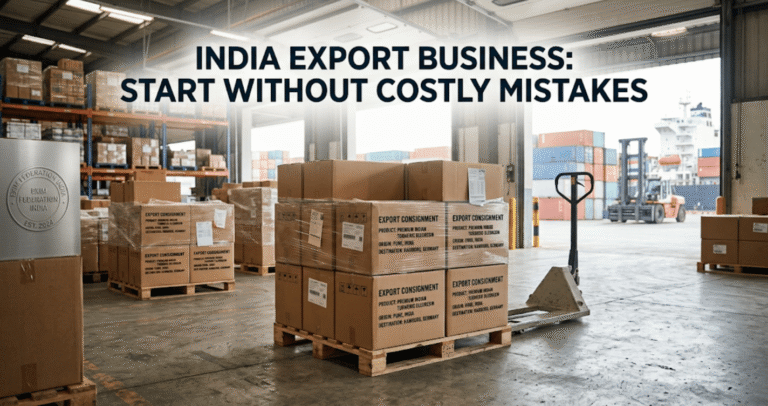
Many people believe that starting an export business only requires finding a foreign buyer and sending products abroad. In reality, an export order can become a costly problem if the product, buyer, documents, pricing, payment terms, and shipment process are not planned properly.
This is why an export roadmap for beginners is important. It gives you a practical sequence to follow before you invest money, promise delivery, or accept your first international order.
Exporting is not simply selling an Indian product in another country. It is a complete business process involving market research, product selection, compliance, pricing, buyer communication, logistics, payment collection, and after-sales support.
Before starting, an exporter should clearly understand:
Which product has demand in the selected market.
Whether the product meets the destination country’s quality and labelling requirements.
What HS code applies to the product.
How much the product will cost after packaging, freight, insurance, customs-related expenses, and other charges.
Which payment method will reduce the risk of delayed or non-payment.
Which documents are required before and after shipment.
For commercial exports from India, the Importer Exporter Code, commonly called IEC, is a key business identification number issued by the Directorate General of Foreign Trade. The official DGFT guidance states that businesses intending to import or export generally need an IEC. You can review the official DGFT IEC guidance before beginning the registration process. cite
Many people believe that starting an export business only requires finding a foreign buyer and sending products abroad. In reality, an export order can become a costly problem if the product, buyer, documents, pricing, payment terms, and shipment process are not planned properly.
This is why an export roadmap for beginners is important. It gives you a practical sequence to follow before you invest money, promise delivery, or accept your first international order.
Many people believe that starting an export business only requires finding a foreign buyer and sending products abroad. In reality, an export order can become a costly problem if the product, buyer, documents, pricing, payment terms, and shipment process are not planned properly.
This is why an export roadmap for beginners is important. It gives you a practical sequence to follow before you invest money, promise delivery, or accept your first international order.
Exporting is not simply selling an Indian product in another country. It is a complete business process involving market research, product selection, compliance, pricing, buyer communication, logistics, payment collection, and after-sales support.
Before starting, an exporter should clearly understand:
Which product has demand in the selected market.
Whether the product meets the destination country’s quality and labelling requirements.
What HS code applies to the product.
How much the product will cost after packaging, freight, insurance, customs-related expenses, and other charges.
Which payment method will reduce the risk of delayed or non-payment.
Which documents are required before and after shipment.
For commercial exports from India, the Importer Exporter Code, commonly called IEC, is a key business identification number issued by the Directorate General of Foreign Trade. The official DGFT guidance states that businesses intending to import or export generally need an IEC. You can review the official DGFT IEC guidance before beginning the registration process. cite
A roadmap helps you avoid making decisions in the wrong order. For example, some new exporters first search for buyers and only later discover that their product requires a special certificate or cannot be shipped under the quoted price.
A planned approach helps in four important ways:
It reduces avoidable mistakes: You know which registrations, documents, and approvals must be completed first.
It improves pricing: Export pricing is calculated after considering the complete cost, not just the factory or purchase price.
It supports better buyer communication: You can answer questions about specifications, delivery, packaging, payment, and documents with confidence.
It protects working capital: A clear plan helps you decide how much money is required for samples, inventory, packaging, freight, and credit periods.
India’s MSME sector remains highly relevant to international trade. Government-reported figures indicate that MSMEs contributed approximately 48.58% of India’s exports and about 35.4% of manufacturing. cite These figures show the opportunity, but opportunity alone does not guarantee success. Preparation and execution matter just as much.
The export process becomes easier when it is divided into manageable stages.
Do not select a product only because it is available locally or because another exporter is selling it successfully. Study the demand, competition, target buyers, pricing, regulations, and shipping feasibility.
A Product Nexus Report can be useful at this stage because it connects product information with possible markets, buyer segments, competition, and commercial opportunities. The objective is not to choose a country based on guesswork. It is to shortlist markets where your product has a realistic chance of selling.
Your business should be ready to receive and make international payments, issue proper invoices, and manage export records.
Depending on your business structure and product, the setup may include:
Business registration and PAN.
GST registration, where applicable.
IEC from DGFT.
A current account with an authorized dealer bank.
AD code and customs-related registrations, as applicable.
RCMC or product-specific registration, where required.
Product certificates, testing reports, or licenses.
The exact requirements may differ for spices, food products, pharmaceuticals, engineering goods, textiles, cosmetics, and other categories. Therefore, a document checklist should be prepared according to the product and destination market.
A good export strategy answers basic commercial questions before you approach buyers:
Who is the ideal buyer?
Which countries should be targeted first?
What quantity can you supply consistently?
What is your minimum profitable order size?
Which Incoterm will you quote?
Will you accept advance payment, a letter of credit, or another arrangement?
How will you handle samples and quality claims?
For instance, a spice manufacturer may have a competitive product but still lose money if the quotation does not include suitable packaging, inland transport, inspection, documentation, and international freight. A proper costing sheet can reveal the difference between a profitable order and an order that only appears profitable.
Getting an enquiry is not the same as getting a safe buyer. Buyer verification should include checking the company website, business registration, email domain, trade history, references, and payment behavior wherever possible.
Be cautious when a buyer:
Pressures you to ship without proper payment security.
Requests unusual fees or payments to an unrelated account.
Avoids sharing complete company details.
Places an unusually large order without discussing specifications.
Refuses a reasonable contract or purchase order.
Your communication should also be professional. Send a clear quotation, product specifications, packing details, lead time, payment terms, validity period, and documents included in the offer.
Export documents should not be prepared at the last minute. Common documents may include the proforma invoice, commercial invoice, packing list, shipping bill, bill of lading or airway bill, certificate of origin, insurance documents, inspection certificates, and product-specific certificates.
ICEGATE provides electronic customs services, including export shipping bill-related facilities and other customs documentation services. cite The exporter, freight forwarder, customs broker, and bank should work from the same shipment details to reduce discrepancies.
Before starting, an exporter should clearly understand:
Which product has demand in the selected market.
Whether the product meets the destination country’s quality and labelling requirements.
What HS code applies to the product.
How much the product will cost after packaging, freight, insurance, customs-related expenses, and other charges.
Which payment method will reduce the risk of delayed or non-payment.
Which documents are required before and after shipment.
For commercial exports from India, the Importer Exporter Code, commonly called IEC, is a key business identification number issued by the Directorate General of Foreign Trade. The official DGFT guidance states that businesses intending to import or export generally need an IEC. You can review the official DGFT IEC guidance before beginning the registration process. cite
A roadmap helps you avoid making decisions in the wrong order. For example, some new exporters first search for buyers and only later discover that their product requires a special certificate or cannot be shipped under the quoted price.
A planned approach helps in four important ways:
It reduces avoidable mistakes: You know which registrations, documents, and approvals must be completed first.
It improves pricing: Export pricing is calculated after considering the complete cost, not just the factory or purchase price.
It supports better buyer communication: You can answer questions about specifications, delivery, packaging, payment, and documents with confidence.
It protects working capital: A clear plan helps you decide how much money is required for samples, inventory, packaging, freight, and credit periods.
India’s MSME sector remains highly relevant to international trade. Government-reported figures indicate that MSMEs contributed approximately 48.58% of India’s exports and about 35.4% of manufacturing. cite These figures show the opportunity, but opportunity alone does not guarantee success. Preparation and execution matter just as much.
The export process becomes easier when it is divided into manageable stages.
Do not select a product only because it is available locally or because another exporter is selling it successfully. Study the demand, competition, target buyers, pricing, regulations, and shipping feasibility.
A Product Nexus Report can be useful at this stage because it connects product information with possible markets, buyer segments, competition, and commercial opportunities. The objective is not to choose a country based on guesswork. It is to shortlist markets where your product has a realistic chance of selling.
Your business should be ready to receive and make international payments, issue proper invoices, and manage export records.
Depending on your business structure and product, the setup may include:
Business registration and PAN.
GST registration, where applicable.
IEC from DGFT.
A current account with an authorised dealer bank.
AD code and customs-related registrations, as applicable.
RCMC or product-specific registration, where required.
Product certificates, testing reports, or licences.
The exact requirements may differ for spices, food products, pharmaceuticals, engineering goods, textiles, cosmetics, and other categories. Therefore, a document checklist should be prepared according to the product and destination market.
A good export strategy answers basic commercial questions before you approach buyers:
Who is the ideal buyer?
Which countries should be targeted first?
What quantity can you supply consistently?
What is your minimum profitable order size?
Which Incoterm will you quote?
Will you accept advance payment, a letter of credit, or another arrangement?
How will you handle samples and quality claims?
For instance, a spice manufacturer may have a competitive product but still lose money if the quotation does not include suitable packaging, inland transport, inspection, documentation, and international freight. A proper costing sheet can reveal the difference between a profitable order and an order that only appears profitable.
Getting an enquiry is not the same as getting a safe buyer. Buyer verification should include checking the company website, business registration, email domain, trade history, references, and payment behaviour wherever possible.
Be cautious when a buyer:
Pressures you to ship without proper payment security.
Requests unusual fees or payments to an unrelated account.
Avoids sharing complete company details.
Places an unusually large order without discussing specifications.
Refuses a reasonable contract or purchase order.
Your communication should also be professional. Send a clear quotation, product specifications, packing details, lead time, payment terms, validity period, and documents included in the offer.
Export documents should not be prepared at the last minute. Common documents may include the proforma invoice, commercial invoice, packing list, shipping bill, bill of lading or airway bill, certificate of origin, insurance documents, inspection certificates, and product-specific certificates.
ICEGATE provides electronic customs services, including export shipping bill-related facilities and other customs documentation services. cite The exporter, freight forwarder, customs broker, and bank should work from the same shipment details to reduce discrepancies.
A planned approach helps in four important ways:
It reduces avoidable mistakes: You know which registrations, documents, and approvals must be completed first.
It improves pricing: Export pricing is calculated after considering the complete cost, not just the factory or purchase price.
It supports better buyer communication: You can answer questions about specifications, delivery, packaging, payment, and documents with confidence.
It protects working capital: A clear plan helps you decide how much money is required for samples, inventory, packaging, freight, and credit periods.
India’s MSME sector remains highly relevant to international trade. Government-reported figures indicate that MSMEs contributed approximately 48.58% of India’s exports and about 35.4% of manufacturing. cite These figures show the opportunity, but opportunity alone does not guarantee success. Preparation and execution matter just as much.
The export process becomes easier when it is divided into manageable stages.
Do not select a product only because it is available locally or because another exporter is selling it successfully. Study the demand, competition, target buyers, pricing, regulations, and shipping feasibility.
A Product Nexus Report can be useful at this stage because it connects product information with possible markets, buyer segments, competition, and commercial opportunities. The objective is not to choose a country based on guesswork. It is to shortlist markets where your product has a realistic chance of selling.
Your business should be ready to receive and make international payments, issue proper invoices, and manage export records.
Depending on your business structure and product, the setup may include:
Business registration and PAN.
GST registration, where applicable.
IEC from DGFT.
A current account with an authorised dealer bank.
AD code and customs-related registrations, as applicable.
RCMC or product-specific registration, where required.
Product certificates, testing reports, or licences.
The exact requirements may differ for spices, food products, pharmaceuticals, engineering goods, textiles, cosmetics, and other categories. Therefore, a document checklist should be prepared according to the product and destination market.
A good export strategy answers basic commercial questions before you approach buyers:
Who is the ideal buyer?
Which countries should be targeted first?
What quantity can you supply consistently?
What is your minimum profitable order size?
Which Incoterm will you quote?
Will you accept advance payment, a letter of credit, or another arrangement?
How will you handle samples and quality claims?
For instance, a spice manufacturer may have a competitive product but still lose money if the quotation does not include suitable packaging, inland transport, inspection, documentation, and international freight. A proper costing sheet can reveal the difference between a profitable order and an order that only appears profitable.
Getting an enquiry is not the same as getting a safe buyer. Buyer verification should include checking the company website, business registration, email domain, trade history, references, and payment behaviour wherever possible.
Be cautious when a buyer:
Pressures you to ship without proper payment security.
Requests unusual fees or payments to an unrelated account.
Avoids sharing complete company details.
Places an unusually large order without discussing specifications.
Refuses a reasonable contract or purchase order.
Your communication should also be professional. Send a clear quotation, product specifications, packing details, lead time, payment terms, validity period, and documents included in the offer.
Export documents should not be prepared at the last minute. Common documents may include the proforma invoice, commercial invoice, packing list, shipping bill, bill of lading or airway bill, certificate of origin, insurance documents, inspection certificates, and product-specific certificates.
ICEGATE provides electronic customs services, including export shipping bill-related facilities and other customs documentation services. cite The exporter, freight forwarder, customs broker, and bank should work from the same shipment details to reduce discrepancies.
A small mismatch in the product description, quantity, value, HS code, or consignee details can create delays. Maintain a shipment file for every order and keep copies of all submitted and received documents.
One common belief is that completing a training programme is enough to become an exporter. Training can explain concepts, but it does not automatically select your product, verify your buyer, calculate your shipment cost, or resolve a documentation issue.
Export business is practical. Each business has different products, suppliers, production capacity, target countries, margins, and compliance needs. This is where implementation-focused consultancy can be valuable.
An export consultant can help you connect the information with your actual business situation. The right guidance may include:
Reviewing product and market suitability.
Preparing an export business setup checklist.
Building a country-wise export strategy.
Checking documents and process sequence.
Evaluating buyer enquiries.
Reviewing quotations and payment terms.
Coordinating with logistics and compliance professionals.
Identifying gaps before the first shipment.
Consultancy does not replace your responsibility as a business owner. It helps you make decisions with better information and fewer avoidable errors.
Exim Federation works with manufacturers, startups, MSMEs, and aspiring exporters who need more than general information. The focus is on understanding the business and then creating a practical action plan.
Depending on your requirement, support may include:
Export Business Setup: Understanding the registrations, documents, and operational requirements.
Product Nexus Reports: Studying suitable markets and buyer opportunities for a selected product.
Export Strategy: Planning product positioning, market selection, pricing, buyer targeting, and shipment execution.
Import Export Consultancy: Receiving practical guidance while implementing the process.
Export Consultancy vs Training: Understanding whether your business needs learning, execution support, or both.
The export process does not have to be confusing, but it should not be treated casually. A roadmap helps you move in the correct sequence, review risks early, and build a stronger foundation for international business.
Exporting involves market selection, compliance, pricing, buyers, logistics, and payment recovery.
An IEC is an important requirement for most commercial import and export activities from India.
Product-specific certificates and destination-country rules must be checked before accepting an order.
Buyer verification is necessary even when the enquiry appears genuine.
Export pricing should include complete shipment and compliance costs.
Training explains general concepts, while consultancy can help apply them to a specific business.
A well-managed first shipment creates the foundation for repeat international orders.
3 months ago
Fantastic experience. Very impressive experience sharing by Mr Shubham. Many complicated terms made easy to understand and approachable. Thank you very much sir.

3 months ago
MSAMB तर्फे आयोजित करण्यात आलेल्या Business Consultation Session मध्ये सहभागी होण्याची संधी मिळाली. शुभम पवार सर यांनी Import-Export व्यवसायाबाबत अत्यंत सखोल, व्यावहारिक आणि सहज समजेल अशा पद्धतीने मार्गदर्शन केले. या सत्रामध्ये एक्सपोर्ट व्यवसायाची सुरुवात कशी करावी, Shop Act, Udyam Registration, कंपनीची स्थापना कशी करावी, कंपनीचे विविध प्रकार, Bill of Lading (BL) म्हणजे काय, Letter of Credit (LC) चे महत्त्व, Vessel मध्ये माल लोड करण्याची प्रक्रिया, RCMC, APEDA Registration, ICEGATE Registration, FSSAI License, Export Insurance, तसेच Export साठी आवश्यक डेटा कसा शोधावा यासह अनेक महत्त्वाच्या विषयांवर सविस्तर माहिती मिळाली. विशेष म्हणजे प्रत्येक विषय प्रत्यक्ष उदाहरणांसह समजावून सांगितल्यामुळे संपूर्ण प्रक्रिया स्पष्ट झाली आणि Export व्यवसाय सुरू करण्याचा आत्मविश्वास मिळाला. Exim Federation टीमनेही अत्यंत व्यावसायिक, संयमी आणि सहकार्याची भूमिका बजावली. सर्व प्रश्नांची समाधानकारक उत्तरे देऊन योग्य दिशा दिली. Import-Export क्षेत्रात व्यवसाय सुरू करू इच्छिणाऱ्या प्रत्येक उद्योजकाने हे मार्गदर्शन नक्की घ्यावे. मी Exim Federation आणि शुभम पवार सर यांच्या Business Consultation सेवांची मनापासून शिफारस करतो. धन्यवाद!

3 months ago
Thank you for the insightful session.

3 months ago
⭐⭐⭐⭐⭐ Excellent Import-Export session by Mr. Shubham Pawar Sir. The session was practical, easy to understand, and full of valuable insights. Thank you, Sir, for sharing your knowledge and motivating us.

3 months ago
Very well explained….

3 months ago
Sir provided very good information and also cleared any questions that I had.