

Vrushali Nagvekar
3 months ago


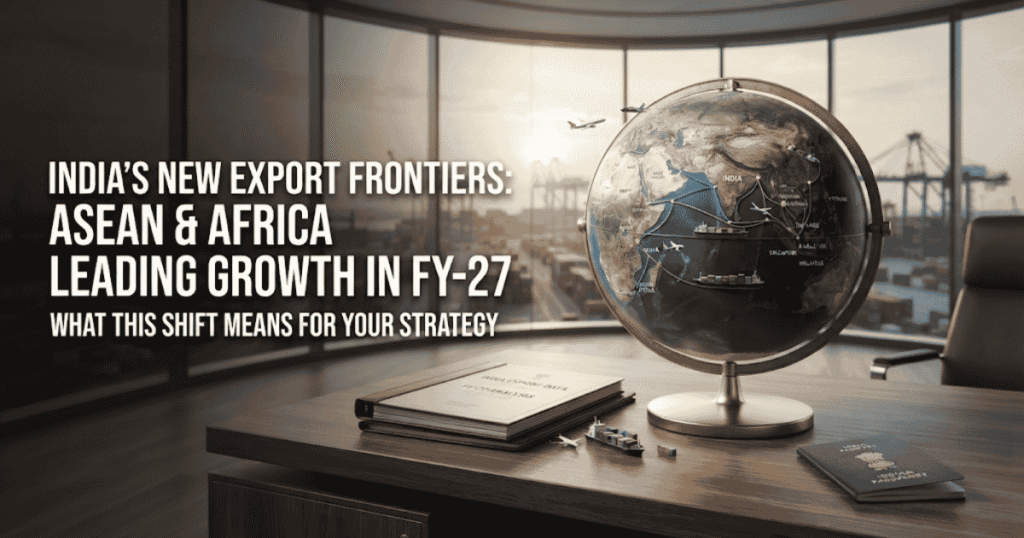
Most Indian exporters still think “USA and Europe” when they hear the word exports, but the data for FY-27 tells a very different story. In the first two months of the year, ASEAN and African economies contributed the biggest share to India’s export growth, with shipments to these regions rising far faster than traditional Western markets. If you are still building your plan only around NAFTA and Europe, you are already late to the party.
Ministry of Commerce data shows that ASEAN, Africa led India’s export growth in the first two months of FY-27 with exports to ASEAN jumping approximately 66.9% and to Africa 53.1% year-on-year in April–May.
Together, these regions added over USD 7.6 billion in extra exports, while NAFTA and Europe grew much more modestly. For a new exporter or MSME, this is not just “big picture news” — it directly affects where you should focus your energy, product research and relationship-building.
In this article, we’ll break down what this shift means, which opportunities are opening up, common mistakes to avoid and practical steps to align your export strategy with this new reality.
When it comes to the India’s exports of goods and services in April–May FY-27 are estimated at USD 162.69 billion overall, with regions outside North America and Europe now more than half of total exports. Within this time period, ASEAN and Africa lead India’s export growth in the first two months of FY-27 by contributing the largest incremental gains.
Key data points you should know:
At the same time, NAFTA remained India’s largest destination but grew only 2.6% and Europe 4%, showing slower momentum compared to these emerging markets.
For MSMEs, the message is simple: growth is shifting where competition is relatively lower and demand is rising faster, especially in sectors like engineering goods, pharmaceuticals, consumer products, food items and petroleum products.
A big misconception among new exporters is that serious export success is possible only if you break into the US or EU first. In reality, the commerce ministry’s data clearly shows ASEAN, Africa lead India’s export growth in the first two months of FY-27, while Western markets are growing but not driving the expansion.
Why this mindset of exporters specially for the new business is risky now:
Training programs often keep talking about “US, UK, EU” because they sound aspirational. The practical truth is that implementation-focused export consultancy aimed at ASEAN and African markets can deliver quicker wins and more sustainable growth for MSMEs.
To make this more firm & workable lets understand this with an example,
consider a small engineering goods manufacturer in Pune producing pumps and basic agricultural equipment. In the past, they tried to target Europe but struggled with certifications, high compliance costs and long sales cycles.
In early FY-27, they shifted strategy after seeing that ASEAN, Africa led India’s export growth in the first two months of FY-27, focusing on markets like Tanzania, South Africa and Sri Lanka.
Step-by-step, they:
Within 12–18 months, their export share from ASEAN and Africa crossed what they previously attempted in Europe, with fewer regulatory hurdles and more responsive buyers.
This is the kind of pivot many MSMEs can make when they read the data correctly and design strategy around it.
If you are planning to enter exports or expand them, here is a practical roadmap based on the current pattern where ASEAN, Africa lead India’s export growth in the first two months of FY-27.
Here are simple, actionable steps you can start in the next 30–60 days:
Key Takeaways
3 months ago
Fantastic experience. Very impressive experience sharing by Mr Shubham. Many complicated terms made easy to understand and approachable. Thank you very much sir.

3 months ago
MSAMB तर्फे आयोजित करण्यात आलेल्या Business Consultation Session मध्ये सहभागी होण्याची संधी मिळाली. शुभम पवार सर यांनी Import-Export व्यवसायाबाबत अत्यंत सखोल, व्यावहारिक आणि सहज समजेल अशा पद्धतीने मार्गदर्शन केले. या सत्रामध्ये एक्सपोर्ट व्यवसायाची सुरुवात कशी करावी, Shop Act, Udyam Registration, कंपनीची स्थापना कशी करावी, कंपनीचे विविध प्रकार, Bill of Lading (BL) म्हणजे काय, Letter of Credit (LC) चे महत्त्व, Vessel मध्ये माल लोड करण्याची प्रक्रिया, RCMC, APEDA Registration, ICEGATE Registration, FSSAI License, Export Insurance, तसेच Export साठी आवश्यक डेटा कसा शोधावा यासह अनेक महत्त्वाच्या विषयांवर सविस्तर माहिती मिळाली. विशेष म्हणजे प्रत्येक विषय प्रत्यक्ष उदाहरणांसह समजावून सांगितल्यामुळे संपूर्ण प्रक्रिया स्पष्ट झाली आणि Export व्यवसाय सुरू करण्याचा आत्मविश्वास मिळाला. Exim Federation टीमनेही अत्यंत व्यावसायिक, संयमी आणि सहकार्याची भूमिका बजावली. सर्व प्रश्नांची समाधानकारक उत्तरे देऊन योग्य दिशा दिली. Import-Export क्षेत्रात व्यवसाय सुरू करू इच्छिणाऱ्या प्रत्येक उद्योजकाने हे मार्गदर्शन नक्की घ्यावे. मी Exim Federation आणि शुभम पवार सर यांच्या Business Consultation सेवांची मनापासून शिफारस करतो. धन्यवाद!

3 months ago
Thank you for the insightful session.

3 months ago
⭐⭐⭐⭐⭐ Excellent Import-Export session by Mr. Shubham Pawar Sir. The session was practical, easy to understand, and full of valuable insights. Thank you, Sir, for sharing your knowledge and motivating us.

3 months ago
Very well explained….

3 months ago
Sir provided very good information and also cleared any questions that I had.
India’s export story in early FY-27 is a strong reminder that real opportunities often move faster than old beliefs. With ASEAN, Africa led India’s export growth in the first two months of FY-27, these regions are no longer side options — they are central pillars of India’s diversification strategy. For a serious MSME or new exporter, this is the right time to align product selection, market focus and documentation with this shift instead of chasing only traditional Western destinations.
Exim Federation can support you with implementation-led Import Export Consultancy, Product Nexus Reports and export strategy design tailored to ASEAN and African markets. If you’re ready to convert this data into action, you can reach us through www.eximfederation.in or call +91-9403733464.
Recent commerce ministry data shows that ASEAN, Africa led India's export growth in the first two months of FY-27, contributing the largest share of incremental exports compared to other regions. These markets are seeing rapid growth in sectors like engineering goods, consumer products, pharmaceuticals and agro-based items. For Indian MSMEs, they offer rising demand, growing trade relationships and less saturation than many Western markets.
You can, but it’s no longer the only or always the best starting point. Western markets have stricter regulations, higher competition and longer sales cycles. Given that ASEAN, Africa lead India's export growth in the first two months of FY-27, many new exporters find it more practical to start with a mix of emerging markets where their products fit local needs and they can build relationships faster.
Demand varies by country but common growth areas include engineering goods, petroleum products, pharmaceuticals, basic consumer goods, food and agro products and infrastructure-related materials. The key is not just to chase broad categories but to map your exact products to HS codes and then check import data and buyer trends for specific target countries.
Training is useful to understand concepts, but many businesses get stuck when they try to implement what they learned — especially around documentation, HS code classification and real buyer discovery. Implementation-led consultancy usually delivers faster results because it is personalized, focuses on your product and market and guides you step-by-step through execution instead of only theory.
You can reduce risk by starting with limited pilot consignments, using secure payment methods like letters of credit where viable, working with reliable logistics partners and veriFY-ing buyer credentials carefully. Also, use official trade statistics and government advisories for each country instead of unverified sources and mark unclear regulatory points as [VERIFY-] until you obtain confirmation from credible authorities or professional consultants.
Choose one product line and shortlist 3–5 potential ASEAN and African countries where it could fit, based on basic trade data and your capacity. Then create a simple Product Nexus sheet listing HS codes, indicative pricing, target buyer segments and questions that need [VERIFY-] before you ship. This turns general interest in exports into a focused plan you can refine with professional support.