

Vrushali Nagvekar
3 months ago


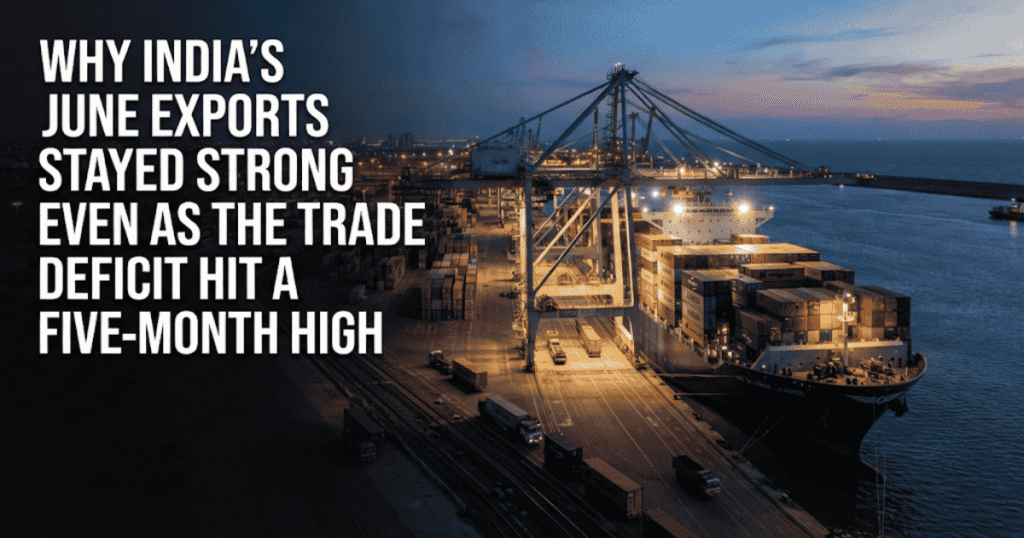
India’s June exports shine through even from the West Asia dark clouds; a trade deficit widened to five-month high and this combination says something which needs to pay an attenuation & equally importance as well: strong export numbers do not always mean a comfortable trade picture.
Many business owners assume rising exports automatically reduce external pressure, but the equally important parameter in the trade deficit i.e. imports can rise faster and change the story quickly.
For exporters, this is not just macroeconomics. It affects pricing, shipping, market choice and the kind of products that stay competitive in uncertain global conditions.
The latest trade data of the ministry of commerce shows a familiar but important pattern:
India’s outbound shipments held up well in June, even as the wider trade deficit expanded. For manufacturers, new exporters and MSMEs.
The real question is not whether exports rose. It is why they rose, which sectors from the exports supported them and how West Asia-linked disruptions can still affect margins, freight and delivery timelines. This article breaks that down in simple terms, so you can understand what the numbers mean for your export plans and where the risks sit.
India’s merchandise exports rose to about $40.41 billion in June, while the merchandise trade deficit widened to a five-month high of $30.43 billion because imports grew faster.
That is the key message behind the headline: export resilience is real, but so is import pressure as well working silently. The broader point is that a healthy export month can still coexist with a weak trade balance if energy, commodities or even the chances of other critical imports becomes costlier.
What matters for business owners is the quality of export growth:
That distinction helps you avoid reading the headline too simply.
West Asia remains important because it influences shipping routes, crude prices, insurance costs and also the confidence of buyers.
Even when exports do not collapse, the region can create indirect pressure from the International freight volatility and input inflation.
That is why a “trade deficit” headline often reflects more than just export performance. It can also reflect costlier imports, especially when crude-linked products move sharply.
For exporters, the practical lesson is straightforward:
A common misconception is that geopolitical stress only hurts exporters shipping directly to the affected region. In reality, the shock often spreads through freight, insurance and raw material prices even for exporters selling elsewhere.
When exports remain strong during uncertainty, it usually points to sectors with either strong global demand or better diversification. Recent trade reporting has highlighted engineering goods, electronics and also in gems & jewellery as important contributors in the broader export trend.
That matters because these sectors tend to reflect capability, pricing discipline and market reach rather than luck alone.
For smaller businesses, this creates a useful benchmark:
A mid-sized manufacturer exporting industrial components to Gulf-linked buyers may not see demand disappear during a regional shock. But the business can still also have chances of losing margin if shipping costs rise, payment cycles stretch or buyers delay replenishment.
A better response is not panic. It is route planning, shorter quoting windows and closer coordination with freight partners and distributors. That is where export strategy work often matters more than generic training.
This is a good time to review your export setup with fresh eyes. Businesses often focus only on getting the first order, but the real challenge is sustaining profitable shipments through volatility. If your pricing model, logistics plan and buyer communication are not built for disruption, a strong export month in the news will not help your own margins.
Practical actions to consider:
If you are still at the stage of setting up exports, this is also a reminder that implementation matters more than theory.
Exim federations Import Export consultancy, product nexus reports and market selection work often save more time than Import export training & institute which are still on the model of ppt based learning & group theoretical training.
For official trade monitoring, the Ministry of Commerce and Industry’s trade analytics and statistics resources are the most relevant starting point. A useful reference is the Government of India’s trade analytics portal:
Key Takeaways
3 months ago
Fantastic experience. Very impressive experience sharing by Mr Shubham. Many complicated terms made easy to understand and approachable. Thank you very much sir.

3 months ago
MSAMB तर्फे आयोजित करण्यात आलेल्या Business Consultation Session मध्ये सहभागी होण्याची संधी मिळाली. शुभम पवार सर यांनी Import-Export व्यवसायाबाबत अत्यंत सखोल, व्यावहारिक आणि सहज समजेल अशा पद्धतीने मार्गदर्शन केले. या सत्रामध्ये एक्सपोर्ट व्यवसायाची सुरुवात कशी करावी, Shop Act, Udyam Registration, कंपनीची स्थापना कशी करावी, कंपनीचे विविध प्रकार, Bill of Lading (BL) म्हणजे काय, Letter of Credit (LC) चे महत्त्व, Vessel मध्ये माल लोड करण्याची प्रक्रिया, RCMC, APEDA Registration, ICEGATE Registration, FSSAI License, Export Insurance, तसेच Export साठी आवश्यक डेटा कसा शोधावा यासह अनेक महत्त्वाच्या विषयांवर सविस्तर माहिती मिळाली. विशेष म्हणजे प्रत्येक विषय प्रत्यक्ष उदाहरणांसह समजावून सांगितल्यामुळे संपूर्ण प्रक्रिया स्पष्ट झाली आणि Export व्यवसाय सुरू करण्याचा आत्मविश्वास मिळाला. Exim Federation टीमनेही अत्यंत व्यावसायिक, संयमी आणि सहकार्याची भूमिका बजावली. सर्व प्रश्नांची समाधानकारक उत्तरे देऊन योग्य दिशा दिली. Import-Export क्षेत्रात व्यवसाय सुरू करू इच्छिणाऱ्या प्रत्येक उद्योजकाने हे मार्गदर्शन नक्की घ्यावे. मी Exim Federation आणि शुभम पवार सर यांच्या Business Consultation सेवांची मनापासून शिफारस करतो. धन्यवाद!

3 months ago
Thank you for the insightful session.

3 months ago
⭐⭐⭐⭐⭐ Excellent Import-Export session by Mr. Shubham Pawar Sir. The session was practical, easy to understand, and full of valuable insights. Thank you, Sir, for sharing your knowledge and motivating us.

3 months ago
Very well explained….

3 months ago
Sir provided very good information and also cleared any questions that I had.
June’s trade data is a reminder that export strength and trade stress can exist at the same time. For business owners, the useful takeaway is simple: do not look only at export growth; look at profitability, route resilience and buyer quality.
If you want to start & expand your business on an international platform with practical guidance & experts with 8+ years of industry experience on Business setup, market targeting or product-level opportunity mapping, Exim Federation can help through step by step consultancy and Product Nexus Reports.
For more details you can
connect – : +91-9403-73-3464
visit us- www.eximfederation.in.
In case of Trade deficit, Exports can grow, but the deficit also widens if imports grow rapidly.
That happens very often when crude oil, industrial inputs or other essential imports become more expensive. Same happened in In June, India’s exports rose, but imports also increased even at rapidly, which actually pushed the trade deficit to a five-month high.
No, not always. A wider trade deficit does not automatically mean exports are performing badly. It reflect higher import bills are also higher compared with exports, especially for energy and raw materials. In other words, a country may still have healthy export momentum while facing external cost pressure from the import side.
West Asia can affect Indian exporters through freight rates, fuel costs, insurance premiums and supply-chain rerouting. Even exporters selling to Europe, Africa or the Americas can feel the impact if shipping routes become costlier or less predictable. That is why geopolitical risk matters beyond direct market exposure.
Sectors with stronger global demand, competitive pricing and better supply-chain control tend to stay more resilient. Recent reporting has highlighted engineering goods, electronics and gems & jewellery as important contributors in export growth. These sectors often benefit from diversified buyers and quicker order recovery.
Yes, that is a common myth. Training can help with awareness, but implementation-focused guidance usually delivers better results because export success depends on pricing, compliance, logistics, buyer targeting and execution. In practice, businesses often need a customized plan, not only information.
Start with landed cost, shipping route options, buyer payment terms and product margin after freight changes. Then check whether your documentation and delivery timelines can absorb delays. If the model only works in a stable environment, it needs redesign before scale.