

Vrushali Nagvekar
3 months ago

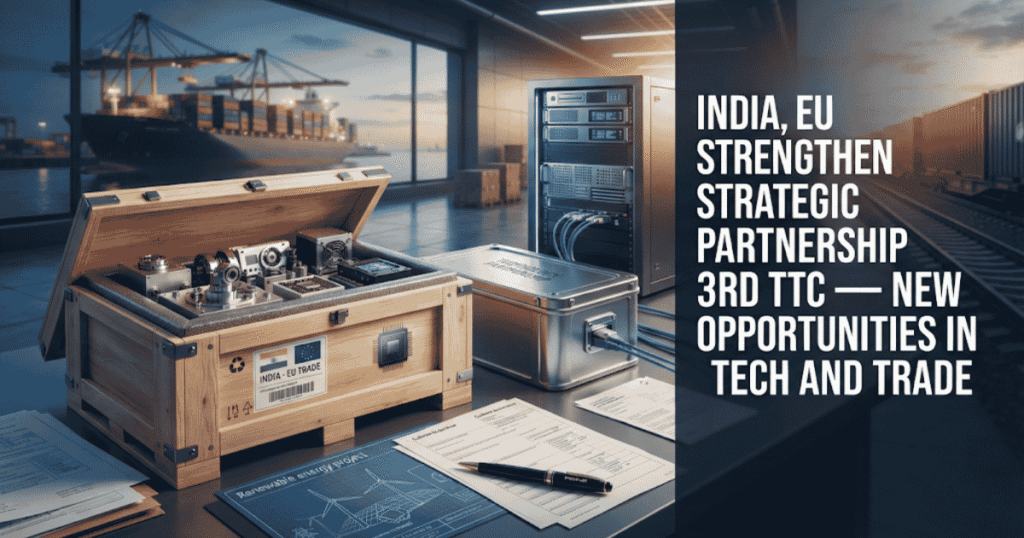
India-EU Trade and Technology Council is no longer just a diplomatic forum now. With the latest meeting, India and the EU are signaling that trade, technology and supply chains will now move together not separately like it has to be previously.
Especially for exporters, manufacturers and startups looking for the change in the eco system. It means new possibilities & openings in advanced manufacturing, digital trust, clean energy and tech collaboration.
The phase of India – EU strengthening their strategic partnership at 3rd TTC is more than a headline for businesses. It mainly reflects a practical shift in how India and the European Union want to work together across business, technology and trusted trade partnership. The immediate question that may arise for business owners is simple: what does this mean in real terms of business development expansion?
The answer matters because the EU is one of the most valuable & high paying markets for Indian exporters, but it is also one of the most demanding. Compliance, product standards, sustainability expectations and supply chain reliability all matter.
In this article, you will see what was discussed, why it matters and where Indian businesses can find opportunities.
The India – EU strengthened strategic partnership at 3rd TTC shows that both sides are treating the TTC as a working platform, not a symbolic one. According to the reports, the both sides are focusing on artificial intelligence, semiconductors, quantum technologies, clean energy and resilient supply chains.
For businesses, that means the partnership is moving into areas where commercial value is created through collaboration, standards and trusted ecosystems. It is not only about government-level agreements. It can shape procurement, research, innovation funding, supplier selection and technology partnerships.
Indian exporters often think EU opportunities are limited to finished goods shipments. That is a common misconception. In reality, this partnership can influence broader business categories such as component supply, co-development, testing, certification and technology-enabled services.
The key commercial signals are:
If your business serves electronics, automotive, renewables, industrial equipment, or engineering goods, this is worth watching closely. Even service providers that support export operations may benefit from new cross-border standards and partnerships.
The most practical opportunities are likely to appear in sectors where India already has capability and the EU is actively looking for reliable partners. The TTC discussions reportedly covered AI, semiconductors, clean energy, hydrogen-related work, battery recycling and startup cooperation.
That opens room for Indian companies in these areas:
A useful example is a mid-sized Indian manufacturer that supplies precision parts for EV systems. Earlier, it may have focused only on price and delivery. Now it can position itself around traceability, quality systems and long-term supply reliability, which are exactly the kind of features EU buyers value.
Many businesses hear a positive trade headline and assume exports will automatically rise. That is not how the EU market works. Good policy direction creates opportunity, but real entry still depends on product readiness, documentation, certification and buyer confidence.
Avoid these mistakes:
The smarter approach is to prepare now. Build product-market fit, create technical data sheets, review compliance and identify target countries and buyer segments before the opportunity window becomes crowded.
The best response to India – EU strengthening strategic partnership at 3rd TTC is preparation. Businesses should use this moment to tighten their export strategy and assess where they fit in the evolving India-EU value chain.
A practical checklist:
One important reference point is the European Commission’s TTC update page, which provides official information on India-EU trade and technology cooperation.
https://digital-strategy.ec.europa.eu/en/news/eu-and-india-strengthen-strategic-partnership-third-trade-and-technology-council
3 months ago
Fantastic experience. Very impressive experience sharing by Mr Shubham. Many complicated terms made easy to understand and approachable. Thank you very much sir.

3 months ago
MSAMB तर्फे आयोजित करण्यात आलेल्या Business Consultation Session मध्ये सहभागी होण्याची संधी मिळाली. शुभम पवार सर यांनी Import-Export व्यवसायाबाबत अत्यंत सखोल, व्यावहारिक आणि सहज समजेल अशा पद्धतीने मार्गदर्शन केले. या सत्रामध्ये एक्सपोर्ट व्यवसायाची सुरुवात कशी करावी, Shop Act, Udyam Registration, कंपनीची स्थापना कशी करावी, कंपनीचे विविध प्रकार, Bill of Lading (BL) म्हणजे काय, Letter of Credit (LC) चे महत्त्व, Vessel मध्ये माल लोड करण्याची प्रक्रिया, RCMC, APEDA Registration, ICEGATE Registration, FSSAI License, Export Insurance, तसेच Export साठी आवश्यक डेटा कसा शोधावा यासह अनेक महत्त्वाच्या विषयांवर सविस्तर माहिती मिळाली. विशेष म्हणजे प्रत्येक विषय प्रत्यक्ष उदाहरणांसह समजावून सांगितल्यामुळे संपूर्ण प्रक्रिया स्पष्ट झाली आणि Export व्यवसाय सुरू करण्याचा आत्मविश्वास मिळाला. Exim Federation टीमनेही अत्यंत व्यावसायिक, संयमी आणि सहकार्याची भूमिका बजावली. सर्व प्रश्नांची समाधानकारक उत्तरे देऊन योग्य दिशा दिली. Import-Export क्षेत्रात व्यवसाय सुरू करू इच्छिणाऱ्या प्रत्येक उद्योजकाने हे मार्गदर्शन नक्की घ्यावे. मी Exim Federation आणि शुभम पवार सर यांच्या Business Consultation सेवांची मनापासून शिफारस करतो. धन्यवाद!

3 months ago
Thank you for the insightful session.

3 months ago
⭐⭐⭐⭐⭐ Excellent Import-Export session by Mr. Shubham Pawar Sir. The session was practical, easy to understand, and full of valuable insights. Thank you, Sir, for sharing your knowledge and motivating us.

3 months ago
Very well explained….

3 months ago
Sir provided very good information and also cleared any questions that I had.
The message from the 3rd TTC is clear: India and the EU want a deeper, more practical partnership. For exporters and manufacturers, that means opportunity is growing in technology-led and compliance-driven sectors, but only businesses that prepare properly will benefit. The real advantage will go to companies that align products, processes and market strategy with EU expectations.
If you want to start & expand your business on an international platform with practical guidance & experts with 8+ years of industry experience on Business setup, market targeting or product-level opportunity mapping, Exim Federation can help through step by step consultancy and Product Nexus Reports.
For more details you can
connect – : +91-9403-73-3464
visit us- www.eximfederation.in.
The India-EU Trade and Technology Council is a formal platform where both sides discuss trade, technology, security and supply chain cooperation. It helps align policy and business priorities in areas like digital trust, green technology and strategic industries. For exporters, it matters because it can shape future market access, standards and collaboration opportunities.
The 3rd TTC meeting is important because it shows that India and the EU are moving from broad intent to specific cooperation areas. The focus on AI, semiconductors, clean energy and resilient supply chains can create demand for Indian suppliers, partners and service providers. Exporters should use this period to improve compliance and market readiness
No, that is a myth. Policy announcements create a better environment, but exports still depend on product quality, certification, pricing, delivery reliability and buyer trust. Businesses that prepare early usually benefit more than those waiting for headlines to translate into direct orders.
Sectors likely to benefit include electronics, semiconductors, EV charging, clean technologies, renewable energy support, industrial components and digital services. Companies that can offer trusted quality, traceability and technical capability will be better positioned. The TTC’s focus suggests that value-added suppliers may gain more than low-margin sellers.
A new exporter should start with product compliance, labeling, documentation, buyer research and a clear export pitch. It also helps to study the target country instead of treating Europe as one market. The EU rewards businesses that show quality systems, sustainability awareness and reliable execution.
Training helps build awareness, but consultancy is often more effective when a business needs actual implementation. That is especially true for compliance, buyer targeting, product positioning and export setup. Businesses usually move faster when they get personalized guidance instead of only general learning material.