

Vrushali Nagvekar
3 months ago

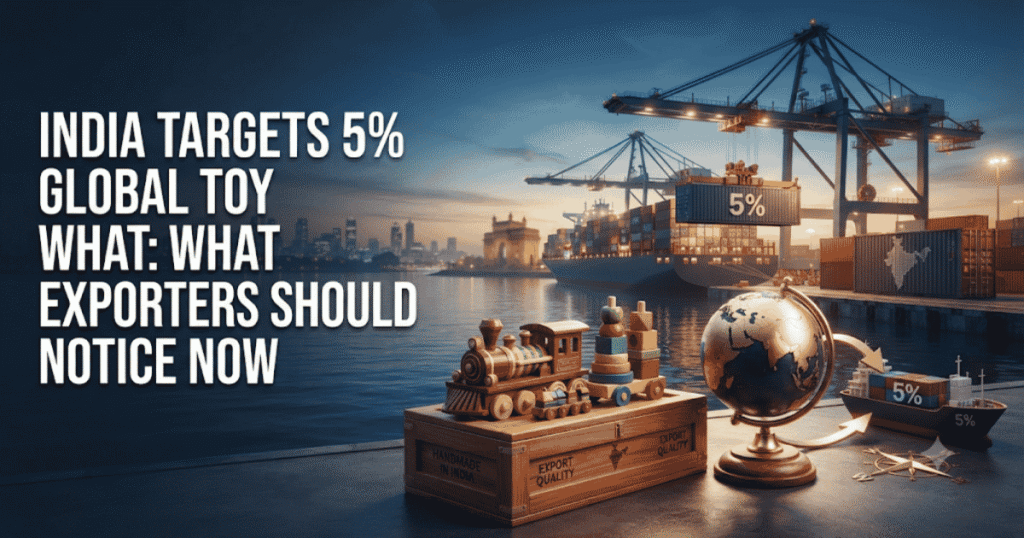
For years, India was seen mainly as a toy importer, not a serious global supplier. This picture is changing rapidly now. India’s toy export push is now tied to a national goal of reaching 5% of the global toy market by 2032, which is a big ambition for a sector that has only recently built stronger manufacturing depth.
This shift matters a lot because toys are not a small size industry anymore.
They touch manufacturing, compliance, design, packaging, logistics and brand building everything at once.
Mainly for exporters, manufacturers and MSMEs, this is a useful signal: the toy sector is moving from low-value trade to a more structured export opportunity. In this article, we will look at why the target matters, what is driving growth, where the practical opportunities are and what businesses should avoid if they want to benefit from India’s toy export push.
Reference – [pib.gov]
The biggest change is policy support. India has tightened quality standards, reduced unsafe imports and pushed domestic production through the Toys (Quality Control) Order and related industry measures. That matters because toy buyers in export markets care about safety, consistency and documentation as much as price.
Reference – [bis.gov]
The other change is momentum. Government statements in recent years show a clear rise in exports and a steady shift toward net exporter status.
The current opportunity is not just about more volume. It is about building a better-positioned supply base for global buyers.
The toy sector is one of the clearest examples of how policy and industry discipline can change trade performance. Official government releases have noted sharp export growth and lower dependence on imports over recent years, while BIS certification has made compliance a central part of the business model.
– Indian toy exports have grown strongly in recent years.
– Toy imports have fallen, which helped local manufacturers gain room in the domestic market.
– BIS certification is now a real entry barrier, especially for weak or informal suppliers.
– FTAs and trade agreements are creating better access in some markets.
This is why many exporters now see toys as more than a domestic manufacturing story. It is becoming an export-ready category with policy tailwinds.
The opportunity is strongest for businesses that can handle both compliance and consistency. Toys are not a “cheap product, fast sale” category. They need product safety, packaging quality, labeling discipline and repeatable sourcing. That is exactly where many new exporters struggle, but also where prepared MSMEs can stand out.
Good entry points include:
– Educational toys and learning-focused products.
– Wooden toys and eco-friendly categories.
– Non-electronic toys with simpler supply chains.
– Private-label manufacturing for overseas distributors.
– Small-batch export orders for niche retailers.
For example:
A small manufacturer in India may start with a limited wooden toy range, secure BIS compliance, improve packaging and then approach a distributor in the UK or UAE. The first order may be modest, but the real win is building a compliant export process that can scale. That is more sustainable than chasing one large order without systems.
Many new exporters assume the toy business is mostly about design or pricing.
In reality, the winning formula is compliance plus reliability plus market fit. If one of these is missing, orders can stop quickly.
Avoid these mistakes:
– Treating BIS compliance as an afterthought.
– Assuming all toys can move across markets without labeling changes.
– Ignoring age-group, material and safety documentation.
– Overestimating demand without checking buyer norms.
– Copying trending products without understanding risk and margin.
A common misconception is that training alone is enough. It is useful, but implementation matters more. Businesses usually need help in selecting the right products, pricing them properly and preparing export-ready systems. That is where consultancy often gives faster results than generic guidance.
If you are planning to enter this segment, start with a practical roadmap:
For exporters, India’s toy export push is not a headline to admire from a distance. It is a signal to prepare your product, paperwork and distribution strategy now.
– India’s toy sector is moving from import dependence toward export expansion.
– Policy support and BIS compliance are shaping the market.
– The 5% global share goal is ambitious and will need execution, not just policy intent.
– Export opportunities are strongest in compliant, quality-driven toy categories.
– MSMEs can benefit if they focus on product selection, documentation and buyer readiness.
– Common mistakes include weak compliance, poor packaging and unclear market targeting.
– Consultancy-led implementation can often work faster than theory-heavy training.
3 months ago
Fantastic experience. Very impressive experience sharing by Mr Shubham. Many complicated terms made easy to understand and approachable. Thank you very much sir.

3 months ago
MSAMB तर्फे आयोजित करण्यात आलेल्या Business Consultation Session मध्ये सहभागी होण्याची संधी मिळाली. शुभम पवार सर यांनी Import-Export व्यवसायाबाबत अत्यंत सखोल, व्यावहारिक आणि सहज समजेल अशा पद्धतीने मार्गदर्शन केले. या सत्रामध्ये एक्सपोर्ट व्यवसायाची सुरुवात कशी करावी, Shop Act, Udyam Registration, कंपनीची स्थापना कशी करावी, कंपनीचे विविध प्रकार, Bill of Lading (BL) म्हणजे काय, Letter of Credit (LC) चे महत्त्व, Vessel मध्ये माल लोड करण्याची प्रक्रिया, RCMC, APEDA Registration, ICEGATE Registration, FSSAI License, Export Insurance, तसेच Export साठी आवश्यक डेटा कसा शोधावा यासह अनेक महत्त्वाच्या विषयांवर सविस्तर माहिती मिळाली. विशेष म्हणजे प्रत्येक विषय प्रत्यक्ष उदाहरणांसह समजावून सांगितल्यामुळे संपूर्ण प्रक्रिया स्पष्ट झाली आणि Export व्यवसाय सुरू करण्याचा आत्मविश्वास मिळाला. Exim Federation टीमनेही अत्यंत व्यावसायिक, संयमी आणि सहकार्याची भूमिका बजावली. सर्व प्रश्नांची समाधानकारक उत्तरे देऊन योग्य दिशा दिली. Import-Export क्षेत्रात व्यवसाय सुरू करू इच्छिणाऱ्या प्रत्येक उद्योजकाने हे मार्गदर्शन नक्की घ्यावे. मी Exim Federation आणि शुभम पवार सर यांच्या Business Consultation सेवांची मनापासून शिफारस करतो. धन्यवाद!

3 months ago
Thank you for the insightful session.

3 months ago
⭐⭐⭐⭐⭐ Excellent Import-Export session by Mr. Shubham Pawar Sir. The session was practical, easy to understand, and full of valuable insights. Thank you, Sir, for sharing your knowledge and motivating us.

3 months ago
Very well explained….

3 months ago
Sir provided very good information and also cleared any questions that I had.
If you are exploring toys as an export Import sector, Exim Federation can help with practical guidance through import-export consultancy, Product Nexus Reports and export business setup support. For business discussions, contact +91-9403733464 or visit [www.eximfederation.in](https://www.eximfederation.in).
Contact: Exim federation By Dattasa environment
+91-9403733464,
website – www.eximfederation.in.
Yes,
the direction is clearly positive. Government releases and industry reporting show higher exports, lower imports and stronger domestic manufacturing capacity. The important point is that this is still a developing opportunity, not a fully mature one. Businesses that enter now with compliance and quality systems can gain an early advantage.
Toys are a safety-sensitive product category. BIS certification is not just paperwork; it is part of market access and buyer trust. Without proper compliance, manufacturers may face rejection in domestic sales and export delays. For exporters, compliance should be planned before production begins, not after the product is ready.
Yes, but only if they choose the right niche. MSMEs often do well in wooden toys, educational products, small-batch private-label supply and customized categories.
The key is not scale first. It is consistent, documentation and a clear export process. A small compliant unit can often outperform a larger but disorganized one.
No. Price matters, but it is rarely the only factor. Buyers also look at safety, packaging, product durability, lead times and the ability to supply consistently. In many export markets, a slightly higher-priced supplier with better reliability can win long-term business. That is why quality systems matter so much in this sector.
The biggest myth is that good design alone will sell abroad. Design helps, but export success needs a full system: compliant materials, tested products, market-specific packaging and dependable production. Without those, even attractive products can fail in buyer evaluation or repeat ordering.
Start with one product category and one target market. Then check compliance, identify buyer expectations and prepare export documents before approaching leads. This reduces waste and helps you build a process that can scale. A focused launch is usually more effective than trying to export many products at once.